
In this article
- Why Villa Roofs in Dubai Need Proper Waterproofing
- Signs Your Villa Roof Waterproofing Has Failed
- Choosing a Villa Roof Waterproofing System
- How Villa Roof Waterproofing Is Done, Step by Step
- Repair, Overlay or Full Replacement?
- What Affects the Cost of Villa Roof Waterproofing in Dubai
- What a Proper Warranty Should Cover
- Keep Your Villa Roof Watertight
- Villa Roof Waterproofing in Dubai With Austenite
- Frequently Asked Questions
Villa roofs in Dubai take more punishment than most roofs anywhere. In summer the roof surface gets far hotter than the air, the slab expands by day and contracts at night, and strong UV breaks down anything left exposed. Then a few heavy winter storms test every joint at once. Villa roof waterproofing is the layer that stands between all of that and your ceilings, walls and electrics.
This guide explains how villa roofs in Dubai fail, which waterproofing systems suit them, how the work should be done step by step, and what to check before you accept it. If water is already coming in, see our roof waterproofing service or book a free inspection.
Why Villa Roofs in Dubai Need Proper Waterproofing
A roof membrane in Dubai has to cope with conditions that would shorten its life in any climate:
- Heat and thermal movement. The slab, screed, parapets and membrane all expand at different rates. Every day that movement pulls at joints, corners and edges.
- UV exposure. Exposed membrane edges, sealants and coatings harden and crack in strong sun unless they are UV-stable or protected.
- Rare but heavy rain. Because it rains so little, a defect can sit unnoticed for years and then show up all at once during the first big storm.
- Equipment on the roof. AC condensers, water tanks, solar frames and satellite dishes all pass through or sit on the membrane. Each one is a possible leak point. See the hidden roof leak points in Dubai villas.
Water that gets past the membrane rarely drips straight down. It travels under the screed and along the slab, so the stain often appears some distance from the defect. By the time it shows, gypsum ceilings, paint and sometimes the steel in the slab are already affected.
Signs Your Villa Roof Waterproofing Has Failed
- Ceiling stains, bubbling paint or a damp smell in top-floor rooms
- Leaks that appear only during heavy or wind-driven rain
- Water pooling on the roof long after rain has stopped
- Cracked, blistered or peeling membrane or coating
- Membrane edges lifting at parapets, plinths and drains
- Hollow-sounding or loose roof tiles, or tiles with open grout lines
- Damp patches on the inside face of parapet walls
One or two of these signs do not always mean the whole roof has failed. Often the problem is a few details. That is why the first step is always diagnosis. Read more on the top causes of roof leakage in Dubai.
Choosing a Villa Roof Waterproofing System
There is no single best system for every villa. The right choice depends on whether the roof is exposed or tiled, what is already on it, how much equipment sits on top, and whether the roof is used as a terrace. These are the systems we use most on Dubai villas.
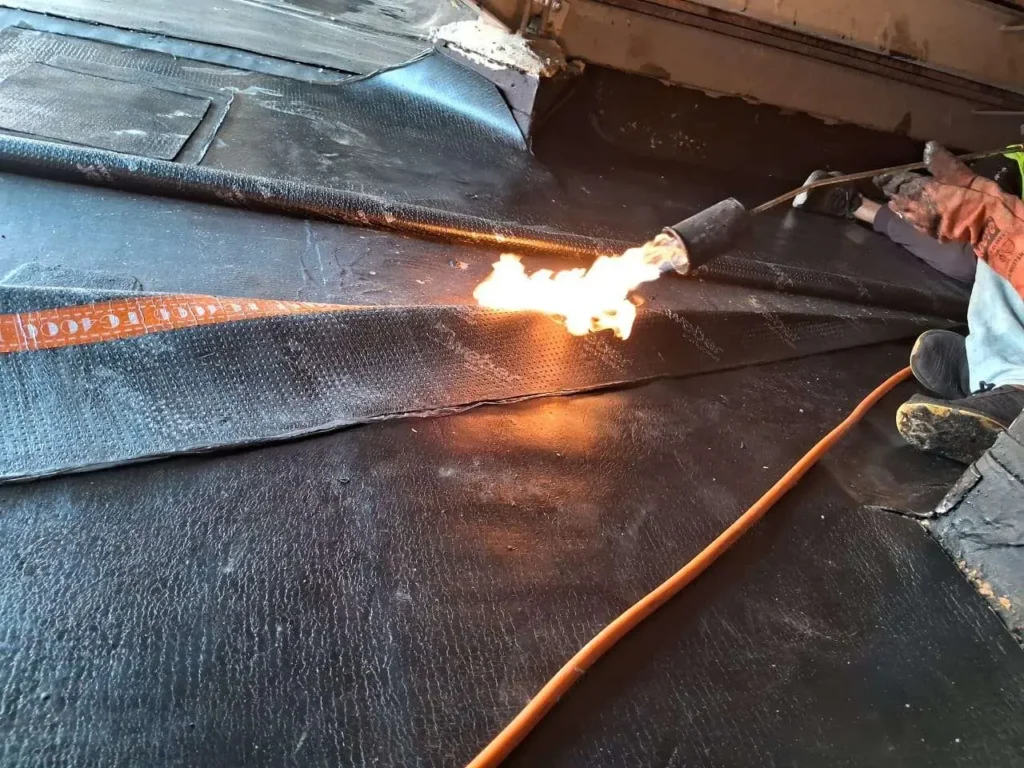
Torch-On Bitumen Membrane
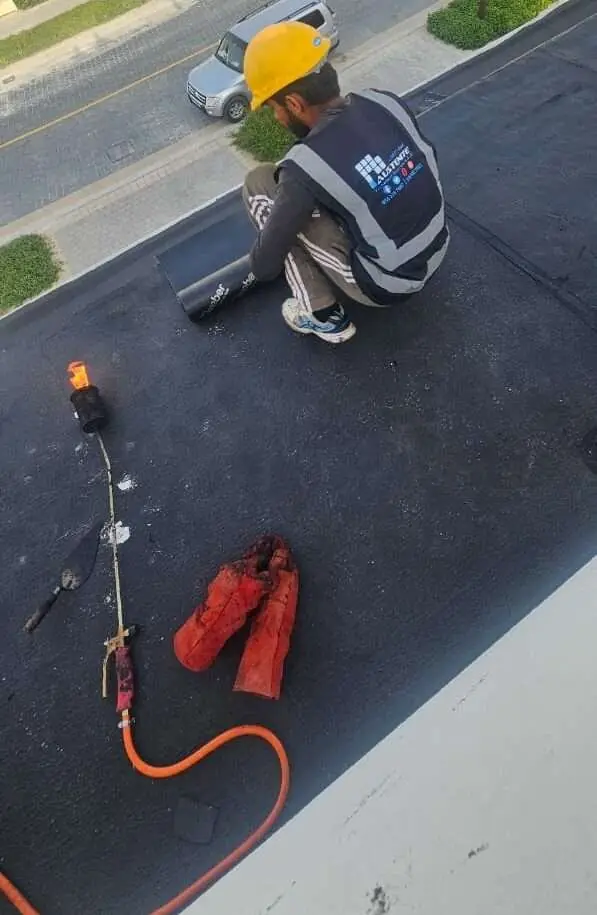
Reinforced bitumen sheets are heat-welded to the primed slab with overlapping seams. The result is a thick, tough layer that handles foot traffic well and works under screed and tiles. Its weak points are the seams and the details, so workmanship matters more than the brand. More on bitumen waterproofing in Dubai.
Liquid-Applied Membrane (PU, Acrylic or Hybrid)
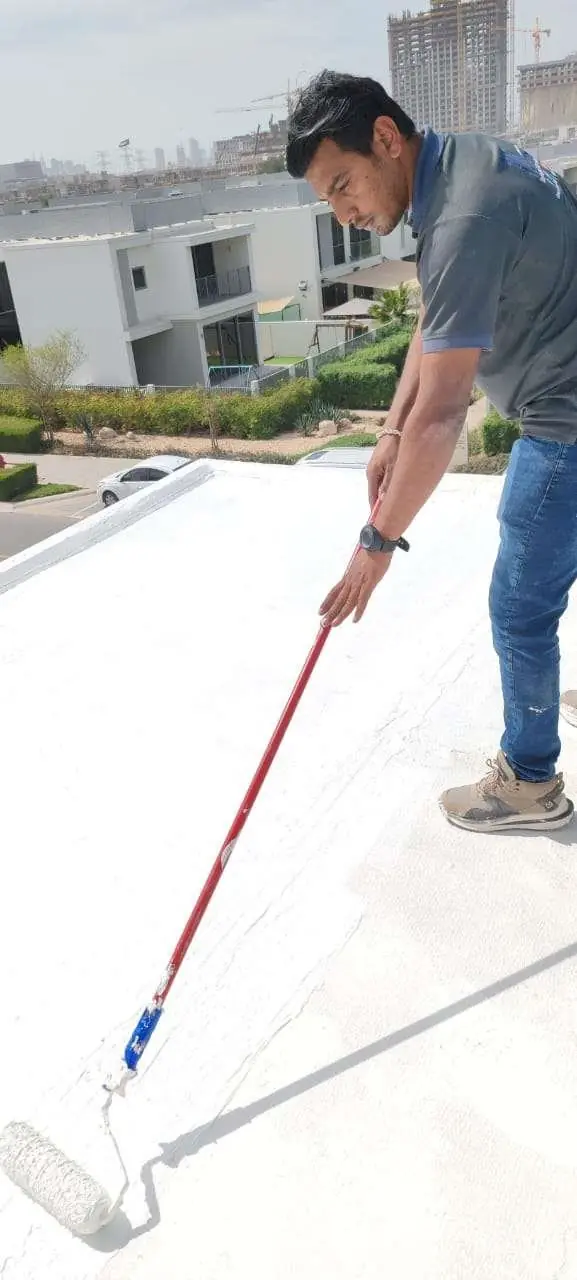
Liquid membranes are rolled or sprayed on in several coats and cure into a seamless skin. They wrap easily around AC plinths, pipes and complex roof shapes, which makes them a good choice for busy roofs and for many retrofits. The key is film thickness. Too thin and the membrane fails early, so a good contractor measures it as the work goes on.
Cementitious Coatings
Polymer-modified cement coatings are used under screed and tiles and in wet areas. They bond well to concrete but have limited flexibility, so they are not the right answer on their own for an exposed roof with a lot of thermal movement.
Reflective Top Coats
A white reflective coat protects the membrane from UV and lowers the roof surface temperature, which also reduces heat gain into the villa. On its own it is a protective finish, not a full waterproofing system.
| System | Best for | Watch out for |
|---|---|---|
| Torch-on bitumen | Roofs that will be screeded and tiled; high foot traffic | Poorly welded seams; needs UV protection if left exposed |
| Liquid membrane | Roofs with lots of equipment and penetrations; retrofits | Thickness applied too thin; poor surface preparation |
| Cementitious coating | Under tiles and screed; wet areas | Cracking where the roof moves |
| Reflective top coat | Protecting and cooling an exposed membrane | Used alone as if it were a waterproofing system |
For a wider comparison of sheet and liquid systems, see membrane waterproofing in Dubai.
How Villa Roof Waterproofing Is Done, Step by Step
1. Inspect and Find the Cause

Before any quote, the roof and the rooms below should be inspected. Thermal imaging and moisture meters show where water is sitting and how it is travelling, so the repair targets the real cause. See thermal imaging leak detection and our leak detection service.
2. Remove Failed Layers and Prepare the Surface
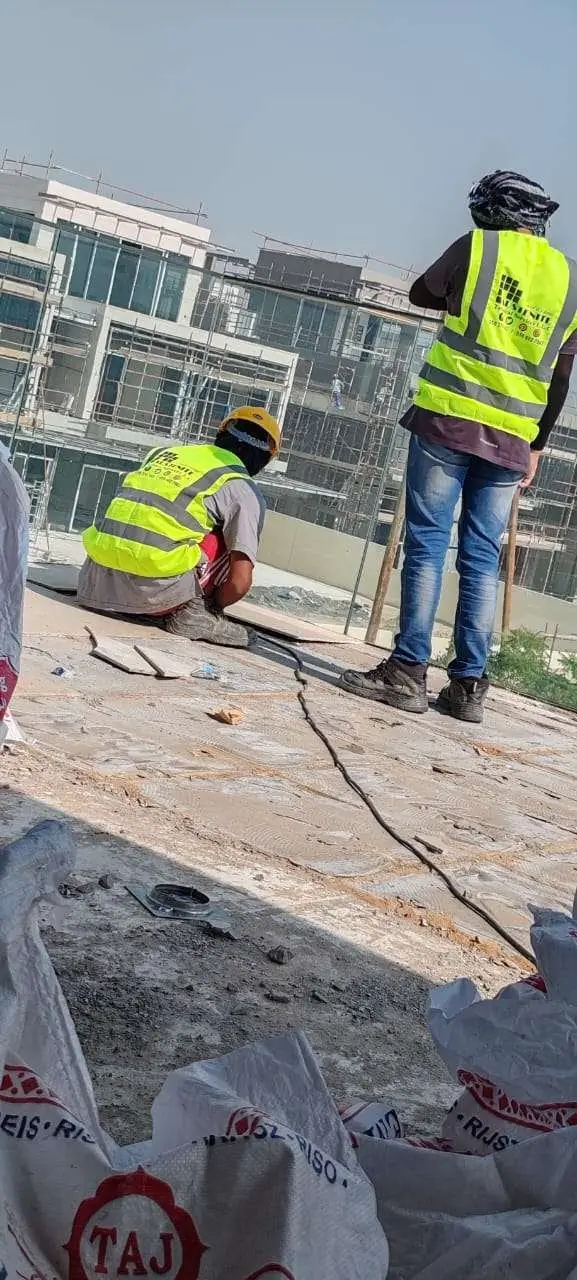
Loose tiles, failed membrane and crumbling screed are removed where needed. Cracks are repaired, the falls to the drains are checked and corrected so water does not pond, and the surface is cleaned, dried and primed. Most early failures trace back to skipped preparation.
3. Detail the Upstands, Drains and Penetrations First
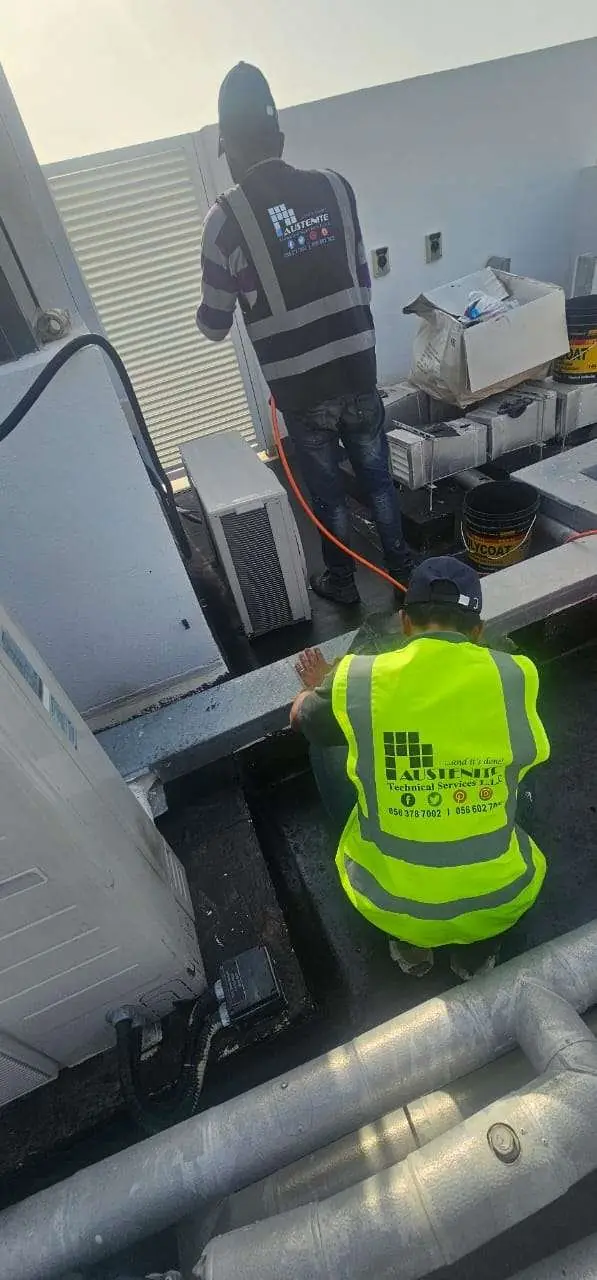
Corners, parapet upstands, drain outlets, AC plinths and pipe entries are reinforced before the main layer. The membrane is carried up the parapet, typically at least 150 mm above the finished roof level, and sealed or fixed at the top edge so water cannot get behind it. Drains get a proper collar bonded into the membrane.
4. Lay the Main Membrane
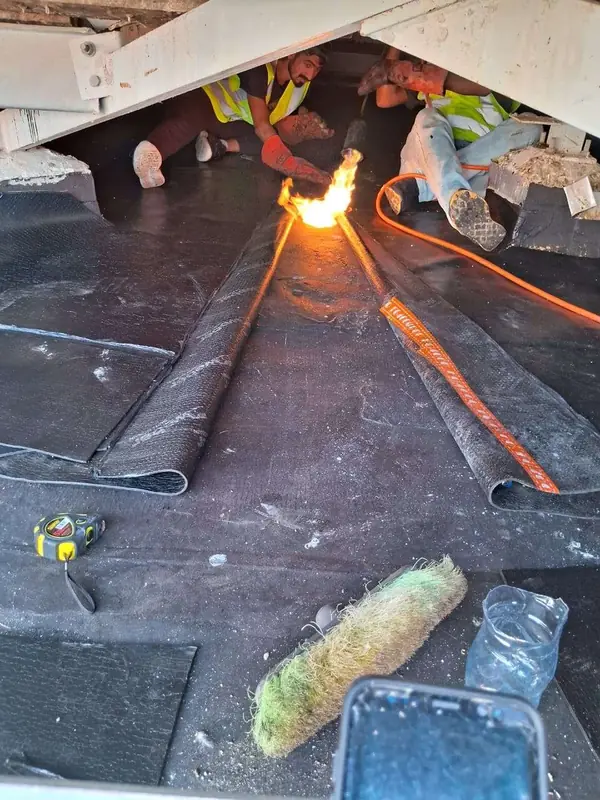
Bitumen sheets are laid with overlapping, fully welded seams. Liquid membranes are applied in coats, usually with reinforcing fabric at the details, until they reach the specified dry film thickness. Either way, the membrane should be continuous from the drains to the top of every upstand.
5. Flood Test Before Anything Covers It
The roof is plugged and ponded with water, usually for 24 to 48 hours, while the rooms below are checked. It is the only reliable proof the membrane holds before screed or tiles hide it. Read why every waterproofing job needs a flood test.
6. Protect and Finish
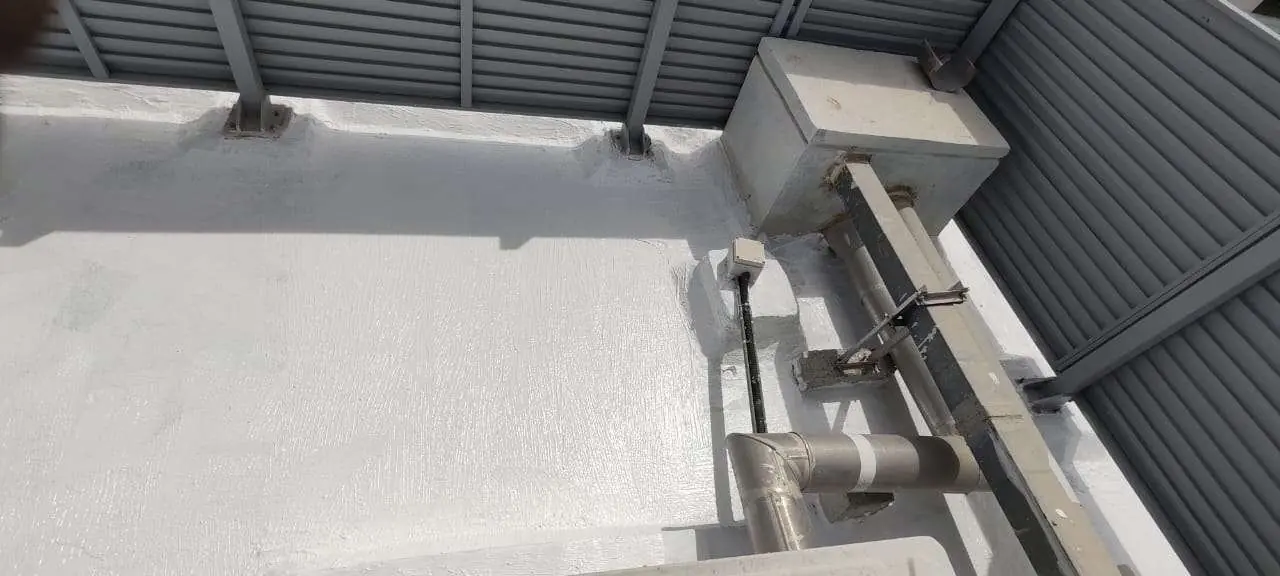
Depending on the system and how the roof is used, the membrane is protected with screed and tiles or finished with a UV-stable reflective coat. Drains are left clear and the roof is handed over with photos of each stage.
Repair, Overlay or Full Replacement?
Not every leaking roof needs to be stripped. If the existing membrane is mostly sound and the leaks come from a few details, targeted repairs at those points can be enough. If the old layer is well bonded, a compatible liquid system can sometimes go over it. A full strip and replacement makes sense when the membrane is brittle or detached over large areas, water is trapped in the screed, or the falls are wrong and the roof ponds. A proper inspection tells you which case you are in.
What Affects the Cost of Villa Roof Waterproofing in Dubai
Every roof is priced on site, but these are the factors that move the price:
- Roof area and shape, including parapets and level changes
- The system chosen and the thickness or number of layers
- How much old membrane, screed or tiling has to be removed
- The number of AC plinths, pipes, drains and other penetrations
- Whether tiles and screed have to be reinstated afterwards
- Access to the roof and moving equipment during the work
- The length and terms of the warranty
A free inspection gives you a written quotation based on your actual roof. Request one here.
What a Proper Warranty Should Cover
A warranty is only useful if it is clear. Before work starts, make sure you get the following in writing:
- The system and products being installed
- The exact areas covered, including details such as upstands and drains
- The warranty period and what the contractor will do if a leak appears
- Exclusions, for example damage caused by other trades drilling into the roof later
- Photos of each stage and a record of the flood test
Keep Your Villa Roof Watertight
Once a year, ideally in October or November before the rain, clear sand from all drains, check the sealing around pipes and brackets, and look for cracks or lifting edges. Before an AC or solar contractor drills into the roof, involve your waterproofing contractor so every new fixing is sealed into the membrane. Our villa waterproofing service covers roofs, balconies, bathrooms and basements.
Villa Roof Waterproofing in Dubai With Austenite
Austenite Technical Services has waterproofed villa roofs in Dubai for more than 25 years, in communities including Palm Jumeirah, Arabian Ranches, Dubai Hills Estate, Emirates Hills, The Springs and Jumeirah Park. We find the cause with thermal imaging, install to Dubai Municipality-compliant methods, flood-test the roof before it is covered, and back the work with a written warranty.
Book your free roof inspection. Call or WhatsApp +971 56 378 7002, or send us photos of your roof or ceiling stain on WhatsApp. We are open 7 days, 9am to 5pm.
Frequently Asked Questions
How long does villa roof waterproofing take?
Most villa roofs take a few working days for preparation and installation, plus the flood test. Roofs that need a full strip-out, new screed or tiling take longer. You get a schedule with the quotation.
Can you waterproof over existing roof tiles?
Sometimes. Some liquid systems can go over sound, well-bonded tiles after testing. If tiles are loose, hollow or water is trapped underneath, they need to come up so the membrane goes onto a sound surface.
When is the best time to waterproof a roof in Dubai?
The cooler months from October to April are easiest for curing and for the crew, and work done before the winter rain protects you when it matters. Summer work is possible with early starts and products suited to high temperatures.
Will new roof waterproofing stop every leak in my villa?
Only leaks that come from the roof. Water can also come from plumbing, AC drain lines, windows or the bathroom upstairs. That is why we diagnose first, so you only pay to fix the real source. See leak detection in Dubai.

Keep reading

Can You Waterproof Over Existing Floor Tiles? Transparent Coating vs Re-tiling (2027 Blog)
If water is leaking in your home, whether from ceiling staining on the balcony, wet grout in the shower, or water entering…
Read article Can You Waterproof Over Existing Floor Tiles? Transparent Coating vs Re-tiling (2027 Blog)
Building Roof Waterproofing for Towers & Podium Decks: Systems Compared (2027 Blog)
If building roof waterproofing in Dubai fails on the roofs or podium decks of buildings, it can cause problems in the areas…
Read article Building Roof Waterproofing for Towers & Podium Decks: Systems Compared (2027 Blog)
AC Units, Pipes and Solar Frames: The Hidden Roof Leak Points in Dubai Villas
Your roof membrane can be in good shape and still leak. In Dubai villas, the water usually gets in where something passes…
Read article AC Units, Pipes and Solar Frames: The Hidden Roof Leak Points in Dubai Villas