
In this article
- Key Takeaways:
- Common Issues in High Rise Tower / Podium Deck Waterproofing
- Common Building Roof Waterproofing Systems in Dubai
- Comparison: Torch-On Bitumen vs Liquid-Applied vs Polyurethane vs Cementitious
- Advantages and Disadvantages
- Differences between Tower and Podium Deck Waterproofing
- Tower waterproofing
- Podium Deck Waterproofing
- Choosing the Right Waterproofing System
- Drainage, Joints, Detailing and Preparation
- Common Mistakes and How to Prevent
- Roof Waterproofing Maintenance and Inspection Tips
- Costs of Building Rooftop Waterproofing in Dubai
- Why Choose a Professional Waterproofing Contractor
- FAQ
- Conclusion: Getting Building Roof Waterproofing Right in Dubai
- Contact Waterproofing Dubai
If building roof waterproofing in Dubai fails on the roofs or podium decks of buildings, it can cause problems in the areas below. Damage can occur to car park ceilings and electrical rooms, while retail areas may develop water stains, leading to dissatisfaction among occupants. Extensive remediation work may also be required to restore the affected areas.
As conditions in roofs and podium decks in Dubai can be harsh, good waterproofing should be considered very seriously. Roofs and podium decks are subject to high temperatures from UV exposure, large temperature fluctuations causing thermal expansion, dust, humidity and heavy rainfalls. In addition, they have plant equipment, landscaping, pools, vehicles and constant foot traffic.
This article describes the different waterproofing options available for building waterproofing in Dubai, and covers which are suitable for tower and podium decks, common mistakes made, and how drainage, detailing and maintenance can influence waterproofing longevity. It can be used by Developers, Building Owners, Facilities Managers, Property Managers, Agents and Construction Professionals, whether they have little knowledge or a large building portfolio.
Key Takeaways:
There is no ‘one size fits all’ solution.
Bitumen membranes are a reliable option for large flat concrete roofs and protected podium decks.
Liquid membranes and polyurethane membranes are ideal in complex roofs with many penetrations, or where there is a requirement for seamless waterproofing.
Cementitious waterproofing is best used in protected areas, below tile/screed.
Selection of waterproofing should consider the exposure, traffic, items on top of roof/podium deck, drainage, and ease of inspection/maintenance.
Common Issues in High Rise Tower / Podium Deck Waterproofing
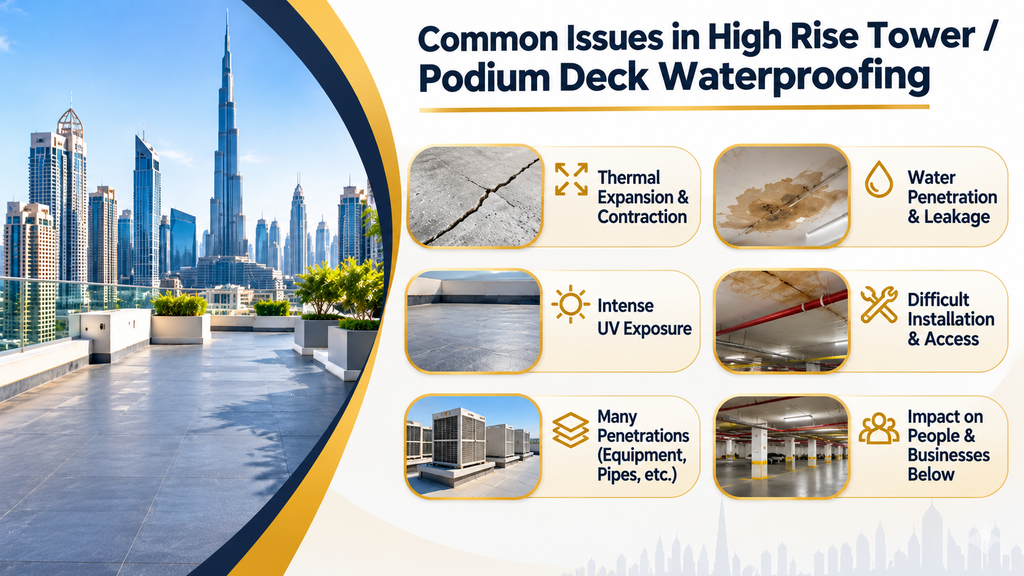
High-rise building waterproofing in Dubai has to cope with some tough conditions.
Roof:
Intense UV exposure, and high temperatures cause many materials to degrade quickly.
Thermal expansion/contraction of concrete. Rigid waterproofing systems can crack in corners and joints due to thermal expansion in the day and contraction at night.
Many penetrations. Many pieces of equipment occupy rooftops (chillers, cooling towers, air conditioning units, water tanks, telecom masts, BMU tracks, solar panels etc), creating many penetrations within the waterproofing.
Difficult to install. Due to height and limited access, installation of materials can be difficult. It is often costly to gain access to rooftops of towers.
Damage from maintenance. Technicians often cause damage to exposed waterproofing membranes by walking over them, dragging equipment, or replacing equipment.
Podium Deck:
Difficult to access membrane. Often there is landscaping, planters, pools, hard surfacing, playgrounds and even vehicle traffic on podium decks meaning the waterproofing can be difficult to access once the surface is in place.
Impact on people/businesses. As there are often car parks, retail areas, lobbies and plant rooms below podium decks, leaking water will impact people and businesses quickly.
Complex drainage. Large podium decks will need to have carefully planned gradients, drainage outlets, and layers to ensure water doesn’t pond under surface finishes.
Movement joints. Podium decks often join to structures of towers, with movement joints. These are common sources of leakage.
Roots and chemical resistance. If planted areas are on podium decks, waterproofing must be resistant to roots. In addition, certain fertilisers and cleaning products may be damaging to certain materials.
These issues can be seen in tower complexes in Business Bay and Dubai Marina, and mid rise residential buildings with shared podium decks in JVC, JVT and Al Barsha.
Common Building Roof Waterproofing Systems in Dubai
In commercial buildings in Dubai, 4 main waterproofing systems are used. All can perform well, depending on their suitability to the location.
Torch on Bitumen Membranes
Reinforced polymer-modified bitumen sheets are applied to primed concrete slabs using torching techniques or self adhesive methods. Overlaps in the membrane provide continuity and are generally protected by a screed, tiles, insulation or surfacing. This is a commonly used system for flat concrete roof waterproofing and podium decks throughout the UAE.
Liquid Membranes
Once applied using brushing, rolling or spraying methods, liquid membranes cure to form a continuous waterproofing membrane. Reinforcement in fabric is often applied to corners, cracks and joints to improve performance. Due to the conformability of this system, they are ideal for complex roofs with many pipework, plinths and equipment bases. Different chemistries are available (acrylic, polyurethane, polyurea and hybrids) meaning performance will depend on the specific product selected.
Polyurethane Membranes
Polyurethane membranes offer flexibility and can bridge small cracks. Some polyurethane membranes can be left exposed, by applying a UV stable topcoat. Others are used in podium decks and car park decks under tiles, screed or traffic bearing surfaces. The flexibility of polyurethane membranes allows them to accommodate daily thermal expansion in Dubai.
Cementitious Membranes
Cementitious waterproofing can be polymer modified to improve flexibility. They bond well to concrete and are often used in protected areas, including below tiles, behind screed, in planters, water tanks and wet areas. These membranes are much less flexible than polymer membranes meaning they are generally unsuitable for exposed moving surfaces.
See more information on sheet and liquid membrane waterproofing in Dubai.
Comparison: Torch-On Bitumen vs Liquid-Applied vs Polyurethane vs Cementitious
| Factor | Torch-on bitumen membrane | Liquid-applied membrane | Polyurethane system | Cementitious system |
| Form | Reinforced sheets with sealed overlaps | Seamless liquid layer, often reinforced | Seamless, highly elastic liquid layer | Brush or trowel-applied cement-based coating |
| Best for | Large flat roofs, podium slabs under protection | Complex roofs, many penetrations, refurbishment | Exposed roofs (UV-stable grades), podiums, decks | Protected areas, planters, tanks, below tiles |
| Handling detail | Good, but laps and corners need skill | Very good around pipes and plinths | Very good | Good on simple shapes |
| Movement tolerance | Good | Good to very good, depending on product | Very good | Limited, unless polymer-modified |
| UV exposure | Needs protection unless a mineral or cap-sheet finish is specified | Depends on product; many need a top coat | UV-stable grades available | Usually needs protection |
| Installation risks | Open flame, weak laps, poor adhesion | Thickness control, surface moisture, curing | Surface moisture, primer choice, curing | Cracking if substrate moves |
| Repairability | Patch repairs possible; locating leaks under protection can be harder | Easy to patch and recoat | Easy to patch and recoat | Easy to patch locally |
Review technical data from manufacturers, and ask your contractor to advise why a particular waterproofing system is most suitable. Even the best waterproofing systems will be limited by the preparation and detailing of substrates.
Advantages and Disadvantages
Torch on Bitumen membranes
Advantages: Proven to be effective in flat areas. Durable and resistant to puncture. Suitable for large areas. Work well in protected areas of podium decks.
Disadvantages: Open flame used can be restricted in buildings in occupation or near flammable products. Poorly installed laps and upstands can create weak points. Once covered by screed/paving, leaks can be difficult to trace.
Liquid Membranes
Advantages: Seamless. Ideal for complex details. Ideal for refurbishment. No open flame required.
Disadvantages: Performance depends greatly on correct thickness and clean/dry surface. Vast variation in product quality within ranges.
Polyurethane membranes
Advantages: Highly flexible. Can bridge cracks. If UV stable grades are used, suitable for exposed areas. Can be adapted for use in podium decks and trafficked decks by using suitable topcoats.
Disadvantages: Sensitive to moisture. Requires correct primers. Generally more expensive than basic coatings.
Cementitious membranes
Advantages: Bond well with concrete. Easy to apply. Cost effective. Suitable for wet substrates and water holding structures if the product is suitable.
Disadvantages: Relatively rigid, meaning cracks may develop in areas of movement. Not typically a first choice for exposed rooftop membranes in towers.
Differences between Tower and Podium Deck Waterproofing
Waterproofing in towers and podiums often occurs in the same development, however often have very different waterproofing requirements.
| Consideration | Tower roof | Podium deck |
| Main exposure | Direct sun, heat, wind | Usually covered by landscaping, paving, pools or traffic |
| Typical loads | Plant equipment, maintenance foot traffic | Pedestrians, planters, soil, water features, sometimes vehicles |
| Access for repairs | Restricted but usually exposed | Membrane often buried under finishes, so repairs are disruptive |
| Critical details | Equipment plinths, pipe penetrations, parapets, outlets | Expansion joints, planter walls, drains, tower-to-podium junctions |
| Typical approach | Exposed UV-stable liquid or polyurethane systems, or protected membranes under insulation and screed | Robust membranes under protection layers, drainage boards and root barriers where planted |
| Biggest risk | Damage from equipment work and UV ageing | Hidden leaks that are expensive to locate and reach |
Tower waterproofing
Waterproofing for roofs in towers in Dubai Marina, Downtown Dubai and Business Bay must often account for intensive plant equipment on roofs and difficult access. To deal with heavy penetrations, and allow for inspection and reapplication, many owners prefer seamless liquid or polyurethane membranes in exposed areas. Alternatively, inverted (protected) systems can be used. Inverted systems have insulation and protection layers applied above the waterproofing membrane, protecting it from heat and foot traffic.
Podium Deck Waterproofing
Waterproofing on podium decks should be reliable, as it is often protected by expensive finishes. In resort style residential buildings in Palm Jumeirah, and podiums containing pools and gardens in Dubai Marina and Downtown Dubai, a waterproofing membrane will often be protected by protection boards, drainage, root barriers, soil and surfacing. It is therefore very important to get the waterproofing right on the first attempt. If leakage does occur above car parks or retail areas, landscaping may need to be lifted to locate the source of the problem. If vehicle traffic occurs on podium decks, a traffic bearing surface or wearing slab protected membrane may be necessary.
Similar issues occur in midrise residential buildings with shared podium decks in JVC, JVT, Al Barsha, Dubai Silicon Oasis and Motor City. The primary risks of water ponding, joint failure and leaking into car park areas below exist.
Choosing the Right Waterproofing System
Consider the following aspects of the roof to determine the best waterproofing system.
1. Exposed / Protected – If exposed, UV resistant products should be selected. If protected, waterproofing membranes should be suitable for the protection layers above.
2. Loading / Traffic – Foot traffic, vehicle traffic, planters, pools and plant equipment can all effect the choice of waterproofing.
3. Complexity – If there are many penetrations and unusual shapes, liquid membranes may be best. If large areas, sheet membranes may be appropriate.
4. New / Refurbishment. If a building is being refurbished, consider whether it is possible to use the existing waterproofing system as a base, or if it needs to be removed. Consider whether open flame processes are allowed.
5. Drainage – Gradients, outlets and drainage layers must be suitable for the waterproofing system.
6. Inspection and Maintenance – Consider how water leakage will be detected and repaired in future.
7. Specification – For new builds, the specification given by the consultants, and requirements from developers and authorities, will be the priority.
More detail on how these decisions are made onsite for roof waterproofing in Dubai can be found here.
Drainage, Joints, Detailing and Preparation
Leakage in roofs and podium decks most commonly occurs at edges, joints and junctions. Therefore, good performance in these 4 areas will give a successful waterproofing system.
Drainage
Water should be able to drain from the roof easily. Ponding water will speed up deterioration, increase loading and leave membranes in wet conditions for long periods of time. Good waterproofing in concrete roofs will begin with correct slopes in the screed/concrete, sufficient drainage outlets, overflow and clear drainage outlets, free from blockages.
Joints
Buildings will move due to temperature and settlement. Expansion joints, particularly between towers and podiums, should be detailed with flexible joints to allow for movement, without tearing the waterproofing. These joints are common sources of leakage on podiums.
Detailing
Parapet and wall upstands, penetrations for pipework, equipment plinths, door thresholds, planter walls and drain outlets all require detailed reinforcement. Experienced installers will produce the best results in these areas.
Preparation
Even the best waterproofing membranes will fail if the surface they are applied to is dusty, weak, wet or contaminated. A good preparation stage will include cleaning, repairing cracks and spalled concrete, removal of failed or loose previous layers, checking moisture content and applying the correct prime. Poor surface preparation is one of the quickest ways to reduce lifespan of a waterproofing system.
Common Mistakes and How to Prevent
Picking a cheap system. If a complex or exposed roof is waterproofed with a cheap system it is likely to fail quickly. Instead consider exposure, traffic and detailing and then compare prices.
Poor surface preparation. If applied to dusty, laitance, wet concrete or failed previous waterproofing layers, adhesion may be poor. Ensure good preparation and primers.
Poor drainage. If a roof is not drained correctly, waterproofing will not help. Ensure correct slopes and drainage outlets are in place.
Poor joint detailing. Most leaks occur at upstands, penetrations, outlets and expansion joints. Ensure reinforcement is in place and these joints are checked before cover is put in place.
Incompatible systems. Different membranes, primers, sealants and coatings may be incompatible with each other. Ensure compatible systems are used in conjunction, ideally from the same manufacturer.
No testing. If a membrane is covered without testing for flooding/leaks, problems may be discovered once decoration is in place.
Damaged by subsequent works. If waterproofing is damaged by subsequent trades (MEP contractors, landscapers, equipment installation), it can cause punctures. Try to protect waterproofing and control subsequent works.
No maintenance. Even the best waterproofing systems will need regular maintenance, drain clearing and minor repairs.
Roof Waterproofing Maintenance and Inspection Tips
Facility managers / Owners Associations can protect investment by carrying out regular maintenance.
Regular checks – Especially before winter rainfall.
Clear outlets, gutters and drainage to remove sand, leaves and debris.
Check high risk joints – Upstands, parapets, movement joints, plinths, pipe penetrations and planter walls.
Look out for indications of problems – Blistering, cracking, edge lifting, ponding water, damaged top coats, and dampness/staining in car parks, plant rooms and top floor units.
Control works on rooftops. Contractors installing / maintaining equipment should protect the waterproofing and report any damage caused.
Record information – Details of the waterproofing system, installation dates, test results, warranty and repair history. This can be useful when selling, refinancing or planning future refurbishments.
If issues do occur, it is important to investigate thoroughly in order to avoid unnecessary removal of large areas of finished decoration. Methods such as moisture surveys, thermal imaging and electronic detection can be carried out.
In shared facilities throughout Dubai, such as clubhouses, community centres and retail buildings in Arabian Ranches, The Springs, The Meadows and Dubai Hills, and mixed use buildings in Meydan, the same principles apply. In private houses in Emirates Hills, Jumeirah Islands, Jumeirah Park and Jumeirah, large flat concrete roofs and terraces may be present, and can benefit from the same principles.
Costs of Building Rooftop Waterproofing in Dubai
Varied costs between different buildings. Consider the following factors to understand why costs may vary.
Type and specification of waterproofing. Coatings, sheet membranes, polyurethane membranes and premium (warrantied) membranes will vary in cost.
Size and complexity. Large open areas may be cheaper per m2. Complex areas with many plant items, penetrations and varying levels will be more expensive.
Condition of existing roof. If existing membranes, screeds, insulation or tiles need to be removed, and concrete repaired, this can be costly.
Items on top. In podium decks, removing and reinstating landscaping, surfacing, pools and drainage layers can be a significant cost.
Access. Materials may need to be hoisted to the roof of a tower. Work hours may be restricted, safety measures may be required and approval from building management may be necessary.
Drainage and joints. Adjusting gradient, increasing outlets and replacing joints can increase the scope of work.
Testing. Watering testing, leak detection, inspection and handing over documentation may be in place.
Occupied building. If working in an occupied building, care may need to be taken to manage work in phases, reduce disturbance and work outside of normal hours.
A site survey is key to getting an accurate quotation. See our waterproofing services page to find out the types of work we can assess to give a quotation.
Why Choose a Professional Waterproofing Contractor
As the consequences of a failure in waterproofing on towers or podiums are high, an experienced waterproofing contractor in Dubai can give the following benefits.
- A waterproofing system most suitable to the building.
- Good preparation and detailing to reduce failure.
- Knowledge of manufacturer requirements to ensure installation is done to technical guidelines.
- Safe working practices. In high rise buildings or occupied buildings, safe working practices are important. If using hot applied systems, hot work controls are in place.
- Testing and quality assurance before finishes.
- Clear documentation of materials, processes and testing for owners, consultants and facilities managers.
- Working with building management, consultants and other trades.
Choosing an experienced contractor can allow developers, owners and facility managers to lower long term maintenance costs.
FAQ
Which is the best waterproofing system for my tower roof in Dubai?
It depends. If an exposed roof has many items of equipment, a seamless UV stable liquid or polyurethane membrane may be best. If a simple large roof, a bitumen membrane with insulation and protection may perform well. It depends on exposure, traffic, detailing and maintenance.
What is the difference between waterproofing podium decks and roofs?
Waterproofing membranes in podium decks are often protected by landscaping, surfacing, pools or vehicle bearing surfaces. Robust protection, good drainage layers and resistance to roots (if planted) is important. Due to difficulty in repairs, it is very important that detailing and testing is correct in podium decks.
Are bitumen membranes better, or liquid membranes?
It depends. Bitumen membranes are durable and are a good choice for large flat areas especially under protection. Liquid membranes are seamless and good for complex details or redevelopments. Many buildings have both.
Can polyurethane membranes be left exposed?
Some polyurethane membranes can be left exposed if UV resistant topcoats are applied. However, some must be covered. Please check technical data for the specific product.
Why are car parks leaking from podium decks?
Common reasons include failure of expansion joints, poor detailing at drainage and planter walls, ponding water, damage from subsequent works, and untested membranes before finishes were applied.
How often should I inspect building roofs and podium decks?
Regular checks are advised. Extra checks should be done before rainy seasons, and after work / installation of equipment on roofs. Keeping drains clear and making quick repairs to small issues makes a big difference.
Can I apply new waterproofing over old waterproofing?
In some cases. If the existing waterproofing is well adhered and compatible with the new system, some liquid waterproofing can be applied to the existing system with preparation. If the existing waterproofing is failing, blistered or causing moisture retention, it is usually necessary to remove it first.
How do I choose a waterproofing contractor in Dubai for my commercial building?
Choose contractors with experience with similar building types. They should be able to clearly explain which system they are proposing. They should pay close attention to preparation and detailing. Testing should be carried out before handing over. Documentation should be clear. They should be able to work safely in high rises and occupied buildings.
Conclusion: Getting Building Roof Waterproofing Right in Dubai
To effectively waterproof roofs on buildings in Dubai (whether in Business Bay, landscaped podiums within Downtown Dubai or communal decking in JVC) a suitable waterproofing system should be chosen for the building, good preparation, detailed joints and penetrations, good drainage and testing should be conducted prior to covering. In addition, regular inspection and maintenance should be performed to ensure minor issues do not lead to larger water ingress issues.
Depending on the building, different systems (torch applied bitumen, liquid applied, polyurethane or cementitious) may be suitable. For optimal performance, it is important to select the correct system for the building.
Contact Waterproofing Dubai
If you are looking to waterproof a new roof/podium, upgrade an existing system or investigate water ingress in your car parks/units, we can help. Find out more about our roof waterproofing in Dubai and membrane waterproofing services, OR Contact Waterproofing Dubai to allow us to visit your site and discuss your requirements.

Keep reading

Top Causes of Roof Leakage in Dubai | Waterproofing Guide
Roof leakage is one of the most common and costly problems faced by property owners across Dubai and the UAE. Whether it…
Read article Top Causes of Roof Leakage in Dubai | Waterproofing Guide
Swimming Pool Waterproofing in Dubai: Complete Guide
Swimming pools in Dubai face constant stress from heat, chemicals, and ground movement. Without proper waterproofing, even a small defect can lead…
Read article Swimming Pool Waterproofing in Dubai: Complete Guide
Cost of Waterproofing in Dubai: Walls, Roof & Pools
Waterproofing is one of the most important investments for property owners in Dubai. Whether it’s damp walls, roof leakage, or pool seepage,…
Read article Cost of Waterproofing in Dubai: Walls, Roof & Pools