
In this article
- Why Penetrations Are the Weakest Point on a Dubai Roof
- The 7 Hidden Roof Leak Points in Dubai Villas
- How to Tell If a Penetration Is Leaking
- How Roof Penetrations Should Be Waterproofed
- Adding AC Units or Solar Panels? Plan the Waterproofing First
- Roof Maintenance Checklist for Dubai Villas
- Fix Roof Leaks at AC Units and Penetrations in Dubai
- Frequently Asked Questions
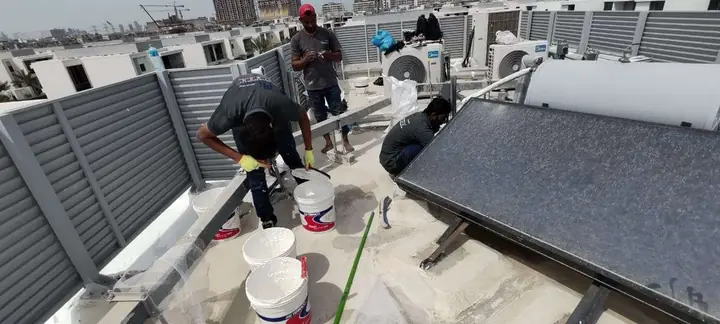
When a villa roof leaks after rain, most owners assume the whole roof has failed and needs replacing. In our experience across Dubai, that is rarely true. The open areas of a roof often perform well for years. The leaks start at the places where something passes through the roof or sits on top of it: AC units, pipes, cable trays, solar frames, drains, parapets and access hatches.
These roof penetrations are the hidden leak points of Dubai villas. They are hard to waterproof, they move differently from the slab around them, and they are often added or disturbed long after the original membrane was installed. This guide explains where they fail, why, and how to fix them properly.
Why Penetrations Are the Weakest Point on a Dubai Roof
A waterproofing membrane works best on a flat, continuous surface. Every time something interrupts that surface, the membrane must be turned up, cut, wrapped or sealed around it. Each of those details is a potential gap.
Dubai adds three extra pressures:
- Extreme thermal movement. Roof surfaces heat up dramatically in summer and cool at night. Metal brackets, PVC pipes, concrete plinths and the membrane all expand at different rates, which pulls at the joints between them every single day.
- UV exposure. Sealants and exposed membrane edges around equipment break down in strong sun, turning hard and cracked.
- Later trades. AC installers, solar contractors, satellite technicians and plumbers often drill, fix or cut into a finished roof with no waterproofing knowledge, and leave the hole sealed with a bead of silicone.
The result is that the roof looks fine from a distance, but water finds its way in at a dozen small points during the first heavy rain of winter.
The 7 Hidden Roof Leak Points in Dubai Villas
1. AC Plinths and Condenser Bases
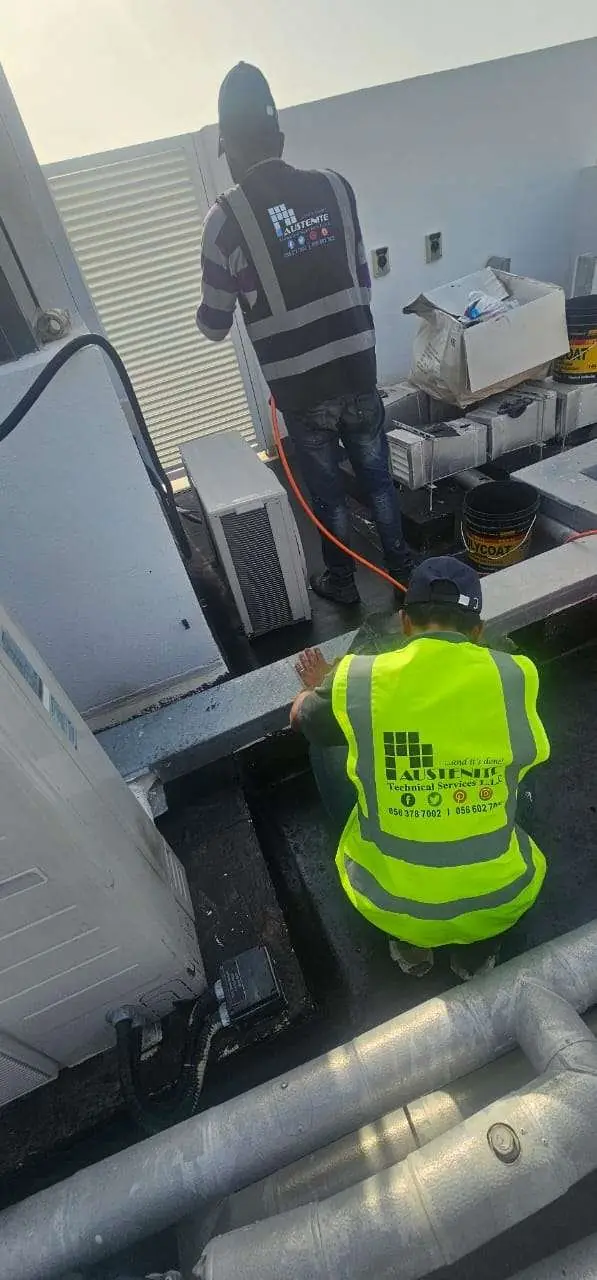
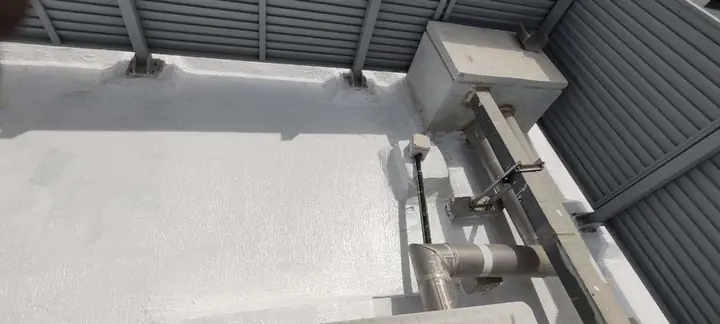
Split and ducted AC condensers usually sit on concrete plinths or steel frames on the roof. If the membrane was not turned up the sides of the plinth and sealed at the top, water runs down the plinth face and under the membrane. Plinths cast after waterproofing are even riskier, as they may sit straight on top of a membrane that was never detailed for them.
2. AC Refrigerant and Condensate Pipes
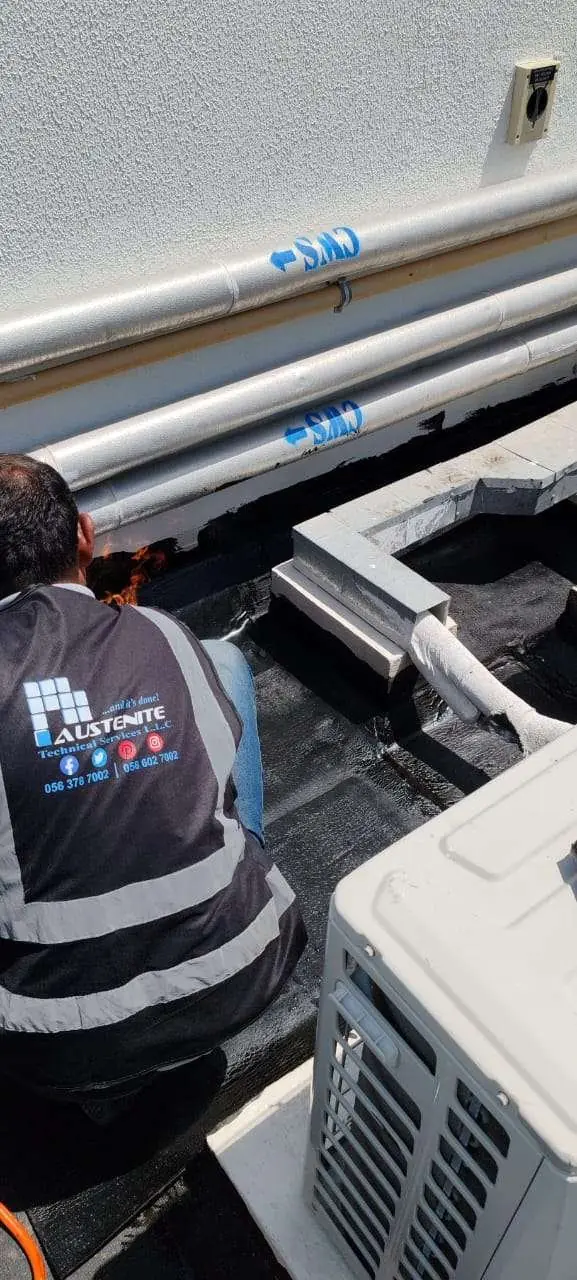
Copper refrigerant lines and condensate drains pass through the roof or parapet to reach the units inside. The sleeves around them are often packed with foam or sealed with silicone that fails within a season or two. Condensate lines that discharge onto the roof surface also keep one area permanently wet, which accelerates any weakness.
3. Upstands and Parapet Walls
The junction between the roof slab and the parapet wall is one of the most stressed details on any roof. The membrane should be turned up the wall to a proper height and protected at the top edge. When the upstand is too low, the top edge is not sealed, or the render above has cracked, water enters behind the membrane.
4. Solar Panel Frames and Water Heater Stands
Solar panels and solar water heaters are increasingly common on Dubai villas. Their frames are often bolted directly into the slab. Each bolt is a hole through the waterproofing. Unless each fixing is sealed into the membrane with a proper detail, or the frame sits on ballasted pads that avoid drilling altogether, these become a cluster of small leaks.
5. Roof Drains and Rainwater Outlets
Drains are where all the water on a roof is meant to go, so any gap here is serious. The membrane must be bonded into the drain body with the right collar, not simply lapped over the edge. Blocked drains are just as dangerous: sand and debris build up during the summer, and when the first heavy rain arrives the water ponds and finds every weak joint nearby.
6. Vent Pipes, Cable Entries and Satellite Fixings
Soil vent pipes, electrical conduits and satellite dish brackets all need their own collars or sealing details. Cable entries added after construction are a frequent culprit, as they are often drilled through the slab and filled with whatever sealant was to hand.
7. Access Hatches and Door Thresholds
Roof access doors and hatches need an upturn at the threshold. Without it, wind-driven rain and ponded water simply run under the door into the stairwell.
How to Tell If a Penetration Is Leaking
Signs that point to a penetration rather than a general membrane failure include:
- A ceiling stain directly below or close to where AC units, tanks or solar frames sit on the roof
- Leaks that appear only during heavy, wind-driven rain
- Cracked, shrunken or missing sealant around pipes and brackets
- Membrane edges lifting or peeling at plinths and parapets
- Water staining down the inside face of a parapet
- Standing water around a drain long after rain
Because water travels under screed and along the slab, the stain inside can be some distance from the penetration that caused it. A leak inspection with thermal imaging traces the path back to the source. See our guide to thermal imaging leak detection.
How Roof Penetrations Should Be Waterproofed
Silicone alone is not a waterproofing detail. A lasting repair treats each penetration as part of the membrane system.
Prepare the Surface
Old sealant, loose membrane and degraded coating are removed around the penetration. The surface is cleaned back to a sound substrate and primed.
Reinforce the Detail First
Before the main coat, the penetration is reinforced. For liquid membranes, this means a reinforcing fabric or mesh embedded around the pipe, plinth or bracket. For torch-on bitumen, it means pre-formed or cut collars and extra strips heat-welded around the base.
Turn Up and Seal the Membrane
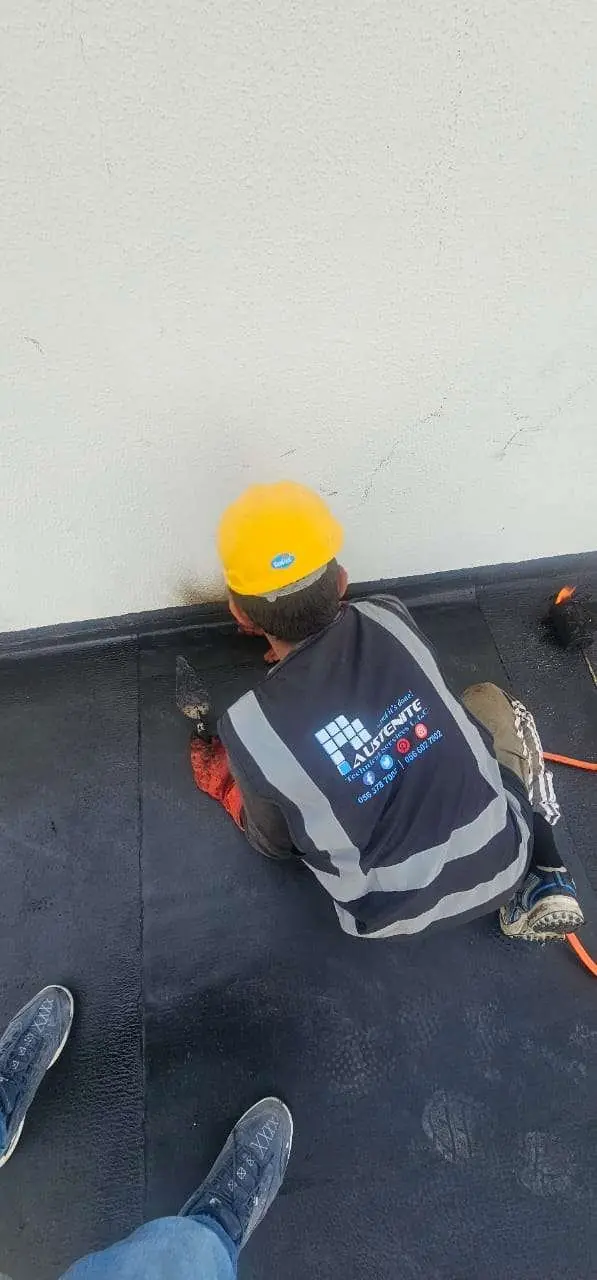
The membrane is carried up the vertical face of every plinth, upstand and pipe to the correct height, then sealed or mechanically fixed at the top edge so water cannot get behind it. Pipe collars are clamped or bonded according to the manufacturer’s system.
Protect Against UV
Exposed details are finished with a UV-resistant top coat. A reflective coating also helps keep the roof cooler, which reduces thermal movement. Read about roof waterproofing in Dubai.
Flood Test the Repaired Area
Before protection or tiles go back, the repaired section is ponded and the room below is checked. Our guide to flood testing in Dubai explains why this step matters.
Adding AC Units or Solar Panels? Plan the Waterproofing First
If you are installing new AC equipment or solar panels, involve your waterproofing contractor before the installer arrives. A few simple decisions prevent years of leaks:
- Use pre-formed plinths or pads that can be fully wrapped by the membrane
- Avoid drilling through the slab where ballasted or bonded fixings will do
- Route pipes through a single sleeved entry instead of several separate holes
- Direct AC condensate to a drain, not onto the open roof surface
- Have every new penetration detailed and tested before the job is signed off
Roof Maintenance Checklist for Dubai Villas
The best time to check your roof is now, before the winter rain. Once a year, ideally in October or November:
- Clear sand and debris from all drains and outlets
- Check sealant around every pipe, bracket and cable entry
- Look for lifting membrane edges at plinths, parapets and upstands
- Check that AC condensate drains discharge into a drain
- Look for cracks in the coating, especially around equipment
- Book a professional inspection if you see anything unusual
For more on why roofs leak in winter, see why Dubai villas start leaking during rain and the top causes of roof leakage in Dubai.
Fix Roof Leaks at AC Units and Penetrations in Dubai
You probably do not need a whole new roof. In many Dubai villas, a careful repair of the penetrations, upstands and drains stops the leaks and extends the life of the existing membrane. The key is finding exactly which details have failed and treating each one properly.
Austenite Technical Services has waterproofed Dubai villa roofs for more than 25 years, in communities including Arabian Ranches, Dubai Hills Estate, Emirates Hills, The Springs and Jumeirah Park. We trace the leak, detail every penetration to the manufacturer’s system, flood-test the repair and back it with a written warranty.
Book your free roof inspection. Call or WhatsApp +971 56 378 7002, or send us photos of the roof or stain on WhatsApp.
Frequently Asked Questions
Can I fix a roof penetration leak with silicone?
Only as a short-term emergency measure. Silicone breaks down quickly in Dubai sun and does not bond into the membrane. A lasting repair reinforces and seals the detail as part of the waterproofing system.
Do I need to remove my AC units to waterproof the roof?
Not always. Many plinths and pipe entries can be detailed with the units in place. Where equipment sits directly on the membrane, it may need lifting briefly so the area underneath can be treated.
Will installing solar panels void my roof warranty?
It can, if new fixings are drilled through the membrane without proper detailing. Talk to your waterproofing contractor before installation so every penetration is planned and sealed.

Keep reading

What Is a Flood Test? Why Every Waterproofing Job in Dubai Needs One Before Tiling
Waterproofing is the one part of a building you never see again once it is finished. A flood test is how you…
Read article What Is a Flood Test? Why Every Waterproofing Job in Dubai Needs One Before Tiling
Water Tank Waterproofing in Dubai: Signs Your Tank Lining Has Failed and Safe Potable Coatings
A leaking concrete water tank damages the building around it and can affect the water you drink. Here are the warning signs,…
Read article Water Tank Waterproofing in Dubai: Signs Your Tank Lining Has Failed and Safe Potable Coatings
Bathroom Leaking Into the Apartment Below in Dubai: Causes, Who Pays and the Permanent Fix
Water coming through the ceiling from the flat upstairs? Here is what usually causes it, who is normally responsible in Dubai, and…
Read article Bathroom Leaking Into the Apartment Below in Dubai: Causes, Who Pays and the Permanent Fix