
In this article
- Key Info:
- Summary:
- Why Water Might be Leaking Through Tiled Floors
- What is a Clear Waterproofing Coating?
- How do clear waterproofing coatings work?
- Can I Waterproof Directly Over Existing Tiles?
- Grout Sealer is not Waterproof
- Transparent Coating vs Complete Re-tiling: Key Differences
- Advantages and Disadvantages of Waterproofing Over Existing Tiles
- When is Re-tiling With New Membrane a Better Option?
- Situations to Consider Waterproofing Tiles
- Common Indicators
- How is a Clear Waterproofing Coating Applied
- Surface Preparation, Grout Inspection and Tile Condition
- Common Errors
- Costs of Waterproofing Floor Tiles in Dubai
- Choosing the Right Waterproofing Method
- Why Choose Professional Waterproofing Services in Dubai
- Frequently Asked Questions:
- Conclusion – What is the best floor tile waterproofing in Dubai?
- Expert Advice on Tiled Surfaces
If water is leaking in your home, whether from ceiling staining on the balcony, wet grout in the shower, or water entering the flat below after washing the terrace, you may be wondering whether floor tiles waterproofing in Dubai can be applied directly over existing tiles to prevent further leakage.
Sometimes it can be a good option, however it is often not the best solution. It can be very disruptive and messy to remove tiles, so in busy locations such as Dubai Marina, or family orientated villas in Arabian Ranches, applying a transparent waterproofing coating can be a faster and less disruptive option. However, sometimes even with a transparent waterproof coating in place the problem still remains.
Key Info:
The reasons for water penetration in tiled flooring, what transparent sealants do, and whether applying waterproofing treatments directly onto tiles (or replacing with new tiles and a waterproofing membrane) is appropriate in Dubai, is explained below. This guidance is intended for homeowners, landlords, property managers, agents, inspectors and contractors to help you make the correct decision.
Summary:
Yes, in certain situations it can be possible to apply waterproofing directly onto tiles. This is appropriate when:
- Tiles are well bonded and grout in good condition
- The floor has good drainage
- Water is penetrating from the surface of the floor (not due to failure in the waterproofing membrane, pipework or structural issues below)
If the tiles are void, loose, incorrectly fixed or the waterproofing has failed, it is generally more suitable to replace the tiles and add a new waterproofing membrane. A transparent coating will provide protection to the surface of the tiles, but will not replace correctly fitted waterproofing membranes.
Why Water Might be Leaking Through Tiled Floors
Although tiles themselves are relatively waterproof, issues can occur in/around the tiles. Water may be leaking through tiled floors due to:
Poor grout – cement grout is porous. Over time, grout can become cracked, shrunk, eroded or discoloured. Water can begin to enter through the gaps in the grout.
Failed waterproofing below tiles – Well constructed wet rooms/balconies will have a waterproofing membrane below the screed or tiles. If this membrane has either not been fitted, been damaged during renovation, or has become cracked and deteriorated over time, water can begin to penetrate through the grout and enter the slab.
Loose/empty tiles – If the adhesive under the tile has failed, there can be gaps created underneath the tiles, which allows water to accumulate.
Incorrect falls – If water is not sloping correctly to the floor drain, water can pool.
Leaking from floor drain/penetration – Water often leaks from the interfaces between the pipe, membrane and drain body.
Water leaking at floor/wall junctions and thresholds – Gaps can develop in silicone and grout at junctions between tiled floors and walls, door frames and glass. Water can seep through these.
Movement and cracking – Cracks can develop in slabs and screeds as they expand and contract with heat and settlement. If movement joints have not been provided, tiles and grout can crack.
Plumbing issues – In some situations, water is coming from pipework in the floor/walls (supply and waste), rather than the tiles.
Note: If water is leaking from pipework, no surface waterproofing will prevent the leak. It is important that the real causes of the water intrusion are identified.
What is a Clear Waterproofing Coating?
A clear waterproofing coating can be applied directly onto tiles and grout. It reduces water penetration at the surface. Although, in reality, this product results in a thin protective layer, and not a complete membrane.
There are various types of clear waterproofing coatings available. They can be:
Film Forming – commonly aliphatic polyurethane or similar. This creates a thin, clear film on the surface of tiles and grout.
Penetrating – commonly Silane/Siloxane products. These penetrate into the porous grout (and some tiles) and help water repel, without leaving a visible film.
Hybrid – A penetrating priming coat with a clear top coat.
Depending on the product selected, certain surface requirements must be met, number of coats used, cure times, slip resistance and suitability for UV exposure/foot traffic will vary. Always refer to technical data sheets provided by manufacturers.
How do clear waterproofing coatings work?
Clear waterproofing coatings stop water penetrating through the surface of the tiles/grout.
Preparation is done to give maximum adhesion/penetration:
- Fine pores and minor gaps in grout and tile edges are filled.
- Once cured, a waterproof layer is formed (film forming) or grout becomes water repellent (penetrating).
- Water is able to run off into drainage rather than penetrating into the gap in the grout.
Note: A clear waterproofing coating only provides protection to the surface of the floor.
Can I Waterproof Directly Over Existing Tiles?
Yes. However, this is only suitable in certain situations. It is suitable in situations where:
Tiles are securely bonded with no hollow sound.
- Most of the grout is in good condition (or can be repaired).
- Floor has correct falls to drainage, and no pooling.
- Water is mainly entering from surface (grout/joints).
- Drainage and pipework are in good condition (or can be sealed individually).
- Area is not constantly wet and not subject to excessive wear beyond that intended for the product.
It is generally not suitable in the below situations:
- Original waterproofing membrane below tiles has failed meaning water has pooled in the screed.
- Tiles are loose/empty/cracked/lifting.
- Incorrect falls causing water to pool.
- Water is coming from pipework, drain body or structural crack.
- Slab has significant movement.
Important! If the waterproofing below the tiles has failed, or there is structural water leakage, waterproofing directly over tiles may not be sufficient. It may only provide some delay to water penetration from above, but may not help to fix broken membranes, re-bond loose tiles, or improve drainage.
Grout Sealer is not Waterproof
Grout sealers can be very beneficial for maintenance. They make grout easier to clean, and reduce water absorption. However, grout sealers on their own cannot be classed as a waterproofing system. They do not protect edges of tiles, drainage interfaces, wall interfaces, or cracks. In addition, they wear over time as they are regularly cleaned and trafficked. Grout sealers should only be considered as a surface protection, and not a true waterproofing membrane.
Transparent Coating vs Complete Re-tiling: Key Differences
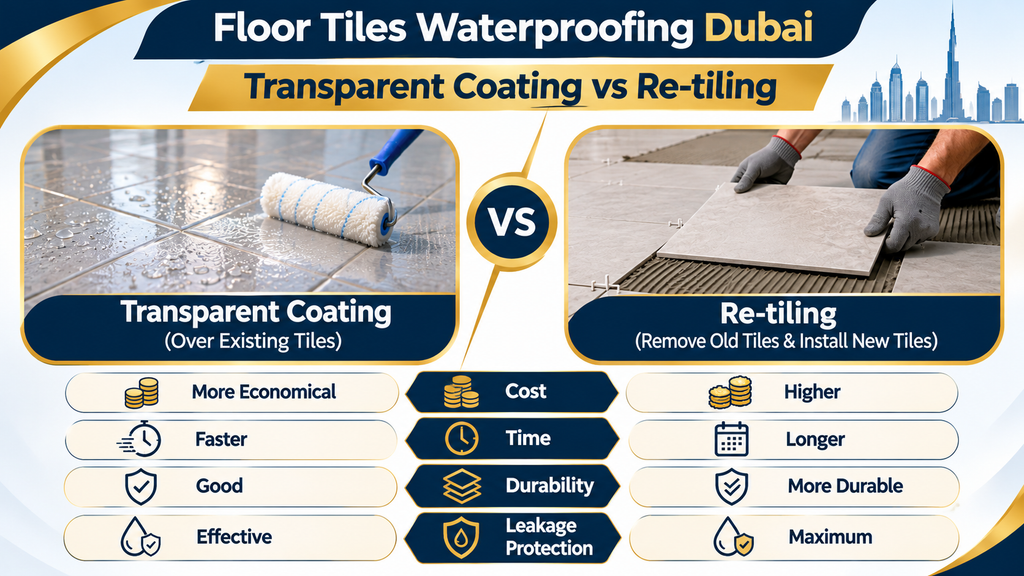
| Factor | Transparent coating over tiles | Re-tiling with new waterproofing |
| What it does | Protects the tiled surface from water penetration | Replaces the waterproofing layer beneath the finish |
| Removes existing tiles? | No | Yes, plus tile bed or screed where needed |
| Disruption | Lower: less noise, dust and debris | Higher: demolition, debris removal, longer downtime |
| Time | Usually shorter | Usually longer, including curing and testing |
| Fixes failed membrane underneath? | No | Yes |
| Fixes loose or hollow tiles? | No | Yes |
| Fixes poor slopes or drains? | No | Yes, falls and drains can be corrected |
| Appearance | Keeps existing tiles; may slightly change sheen | New tiles and fresh finish |
| Maintenance | Needs periodic inspection and recoating | Membrane protected under tiles; grout and silicone still need care |
| Best for | Sound tiled floors with surface-level seepage | Failed waterproofing, damaged tiles, poor drainage, recurring leaks |
Choosing between clear waterproofing and re-tiling depends on identifying the cause of water leakage.
Advantages and Disadvantages of Waterproofing Over Existing Tiles
Advantages
Less disruption. Tiles are not broken so less noise and mess. This is very useful in occupied properties or towers with strict working hours.
Faster. This is a good option between tenancies or prior to viewings.
Existing tiles in good condition (or difficult to match) are preserved.
Less work required. As no demolition, debris clearance or new tiles are required.
Disadvantages
Does not fix issues below tiles. If there is failed waterproofing below tiles, water trapped in the screed, loose tiles or incorrect falls in the flooring, the issue will not be resolved.
Dependent on surface preparation. To be effective, good surface preparation is important. This includes cleaning, drying and any grout repairs.
UV Exposure and Wear. If applied to balconies, terraces and highly trafficked areas, reapplication may be required periodically.
Appearance and slip resistance may vary depending on the product. Important to consider in wet areas or external tiles.
May mask the true issue. If there is a deeper issue below the tiles, coating may only cause a delay in repairing the issue, whilst damage continues below.
When is Re-tiling With New Membrane a Better Option?
Re-tiling with a new waterproofing membrane is usually the correct option if:
Water continues to leak after grout repairs.
- Tiles sound hollow, rattle, crack or lift showing that the bonding below has failed.
- Water is pooling due to incorrect falls.
- There is evidence that the original waterproofing membrane has failed (ongoing staining in ceiling below, efflorescence, or damp in slab).
- Floor drains or pipe interfaces require replacement, or resealing into new membrane.
- Property requires renovation anyway. It is therefore most cost effective to correctly waterproof at this point.
- Originally, the floor had inadequate waterproofing. (Not unusual in older properties or fast refurbishments.)
By lifting tiles, a contractor can fix the screed and falls. Once correct falls are in place, the waterproofing membrane can be fitted, and a flood test carried out. Only once this has been completed, can new tiles be fitted. Initial work is more extensive, however, the root cause is being fixed.
Situations to Consider Waterproofing Tiles
Bathrooms
Waterproofing floor tiles in bathrooms is very common in Dubai. In units in towers across Downtown Dubai and Business Bay, a stained ceiling is often the initial cause for investigation. For tiles in good condition and worn grout, a clear coating may be suitable. However, ongoing leakage in showers usually indicates the membrane below requires replacement.
Kitchens
Kitchens experience spillage, cleaning and occasionally leaks from appliances (dishwashers, fridges with water lines and washing machines). Coatings can reduce regular water seepage. However, if the leak is due to hidden pipework, plumbing issues must be fixed. In busy rental properties in JVC and JVT, low disruption coatings may be required between tenancies, providing the cause of the leak has been investigated.
Balconies/Terraces
Waterproofing floor tiles on balconies is a common issue in high rise buildings in Dubai Marina, Palm Jumeirah and Downtown Dubai. Balconies in villas in Emirates Hills, Jumeirah Islands, Jumeirah Park and Dubai Hills also experience similar exposure. As these areas can be exposed to UV light, waterproofing products must be suitable for external use. Hollow tiles and poor drainage are common in these areas, so careful consideration must be given.
Laundry Rooms/Maids Bathrooms/Utility Rooms
Laundry rooms, maids bathrooms and utility rooms in villas in Arabian Ranches, The Springs and The Meadows often have old grout and basic waterproofing. Inspection may be required and in some cases, a clear coating may be suitable if tiles are in good condition.
External Tiled Areas
Pool areas, courtyard areas, entrance steps and external kitchens will all be exposed to UV, water and foot traffic. UV resistance, slip resistance and drainage are key considerations. Grout may be protected with a coating, however it must be suitable for external, wet and trafficked areas.
The same applies to community buildings, apartment blocks and older villas in Al Barsha, Meydan, Dubai Silicon Oases, Motor City and Jumeirah. Grout and sealants in these areas may be worn due to years of use.
Common Indicators
- Staining, blistering paint or dampness on ceiling below bathroom/kitchen/balcony.
- Dampness on wall next to shower or balcony door.
- Dark, cracked, missing and crumbling grout.
- Hollow sound from tiles, tiles moving or raised edges.
- Water remaining on floor after showering/washing.
- White powdery deposits (efflorescence) on grout or underside of balcony.
- Musty odours and recurring mould at bottom of walls.
- Gaps in silicone around floor drains, shower screens and thresholds.
A single indicator may just require a small fix. Multiple indicators usually indicate water getting below the tiles.
How is a Clear Waterproofing Coating Applied
Depending on product, however in general, applying a waterproof coating to tiled surfaces should be carried out as follows.
Investigate water leak: Determine the cause of the water leak. This can be done visually, using moisture meters and, if required, water testing/leak detection. First rule out leaking pipework and faulty drainage.
Inspect tile and grout conditions: Tap tiles to check for hollow tiles. Check for cracks and raised edges in tiles. Inspect grout and silicone.
Fix issues: Reattach loose tiles, dig out damaged grout and replace. Reapply silicone around drains, walls and thresholds.
Thoroughly Clean: Remove soap scum, grease, effloresence, old sealers and dirt from surface to allow good adhesion/penetration.
Dry Surface: Ensure surface is completely dry. A common cause of failure is applying coatings to damp grout.
Protect Surfaces: Protect walls, fittings, drains and doors from overspray.
Apply Primer/First Coat: As per manufacturers instructions. Ensure grout lines and edges of tiles are covered.
Apply Further Coats: As per manufacturers instructions, ensuring correct drying time between coats.
Cure: Do not use area until fully cured. If applicable perform a controlled water test to confirm effectiveness.
Provide Care Instructions: Provide instructions on what cleaners to avoid, and when inspections/reapplication should occur.
Surface Preparation, Grout Inspection and Tile Condition
These considerations will determine whether waterproofing can be applied without removing tiles.
Tile Bonding: Tiles should be securely bonded across. If tiles sound hollow, there is likely to be voids underneath which could cause water to pool. In most cases, tiles will need to be lifted and reset.
Grout Condition: If grout is cracked, missing or crumbling it must be replaced prior to application. Large gaps may not be reliably sealed with a coating.
Waterproofing Below Tiles: If there is evidence that the waterproofing membrane below has failed (ongoing staining below, water in screed, or water leakage even after surface repairs), waterproofing on the surface will not fix this issue.
Drainage: Ensure water is draining well into floor drain. If falls are incorrect, it is likely that re-screeding and re-tiling is required.
Drainage and Penetrations: Floor traps, pipe sleeves and fittings must be properly sealed. Often, these are where water is leaking from.
Movement Joints: On large floors, balconies and terraces flexible movement joints must be provided to allow movement without cracking.
Type of Tile Finish: Some polished, glazed and textured tiles will affect how well the coating adheres to the surface, and may cause more slip. It may be advisable to perform a small test patch.
Common Errors
- Applying waterproofing over loose/empty tiles causing water to be trapped. Hiding the real issue.
- Skimping on grout repairs and assuming wide/crumbling gaps can be sealed with a waterproofing coating.
- Applying coatings to damp areas. This can cause poor adhesion, whitening or flaking.
- Ignoring issues at floor/wall junctions. Many leaks occur here.
- Using internal products outside without checking suitability for UV exposure and weather.
- Not considering slip resistance. Important to consider on bathrooms, balconies and pool areas.
- Assuming grout sealers are waterproof. They only provide surface protection.
- Using a waterproofing coating as a temporary measure, whilst water continues to damage the slab and ceiling below.
- No maintenance plan. Exposed waterproofing coatings will require periodic inspections and reapplication.
Costs of Waterproofing Floor Tiles in Dubai
Prices will differ depending on the project. However, understanding some of the factors affecting cost can be useful.
Type of Waterproofing: Waterproofing tiles with a clear coating (on good condition tiles) will be less work than re-tiling with a new membrane.
Size/complexity of area: Smaller complex bathrooms with lots of fittings will take longer per square metre than open balcony areas.
Tile/Grout Condition: If re-grouting is required, tiles are empty and drains need re-sealing, this will increase the amount of work.
Product Type: Different coatings/membranes will require different levels of material and labour.
Exposure: If tiles are external or on a balcony, products may be required to be UV resistant and suitable for foot traffic.
Demolition/Reinstatement: If re-tiling, demolition, debris clearance, repair of screed, new tiles, adhesive and grouting is required.
Access/Rules: In high rise buildings, working hours may be limited. Lifts may need to be booked, and approval of building management may be required.
Investigation/Testing: Leak detection and flood testing increases the amount of work however reduces the risk of fixing the wrong issue.
To get an accurate quotation for waterproofing tiles in your property, a site visit is essential.
Choosing the Right Waterproofing Method
Ask yourself (or a professional):
Where is the water coming from? Is it coming from surface water, failed waterproofing membrane, drain, pipework or crack?
Are the tiles in good condition? If many tiles are empty/hollow, re-tiling is likely to be required.
Is water draining correctly? If not, waterproofing will not fix pooling.
Is the area internal or external? If external waterproofing products must be suitable for UV and weather.
How much disruption is acceptable? If the property is occupied or rented, a clear coating may be preferable (providing conditions are suitable).
What is the future plan? If renovation is planned soon, it may be best to fully waterproof at this point.
If the cause of the water appears to be on the surface of good quality tiles, a clear coating may be a good low disruption option. If it appears to be due to issues below the tiles, re-tiling with a correctly applied membrane is a more reliable option.
Why Choose Professional Waterproofing Services in Dubai
The most difficult part of waterproofing tiles is determining the cause of the issue and deciding on the correct repair. Our experienced waterproofing contractors in Dubai can help by:
- Identifying the true cause of the leak.
- Giving an honest assessment of tile/grout condition, drainage and falls. We will be honest if a coating isn’t suitable.
- Choosing suitable products for the area, whether wet internal areas, exposed balconies or external terraces.
- Providing proper surface preparation (often lacking in cheap DIY jobs).
- Fitting correct membranes if re-tiling is required.
- Carrying out testing.
- Working within building rules in flats/managed properties.
Whether you need a clear coating on a balcony, bathroom floor tiles waterproofing or a full re-tile with a new membrane, our floor waterproofing services in Dubai cover assessment through to completion. For leaks on top-floor ceilings, the cause may be the roof instead. Our roof waterproofing page explains that side of the problem.
Frequently Asked Questions:
Can transparent waterproof coatings be used on tiled floors?
Yes. If the tiles are secure, the grouting is in good condition (or can be repaired), water is coming in from above, and the floor is draining correctly, applying this type of coating may be suitable. However, if the membrane underneath has failed or tiles have become loose, re-tiling with waterproofing is typically required.
What is transparent tile waterproofing?
A waterproof layer applied directly over tiles and grouting. There are two types of coating, those which create a very thin transparent layer, and those which penetrate into the grouting to make it waterproof. This will waterproof the surface however it cannot replace a membrane underneath the tiles.
Is applying waterproofing directly over tiles more effective than re-tiling?
Not always. Applying waterproofing directly over tiles can be a good option for surface ingress and on floors in good condition. Re-tiling may be a more reliable option if the membrane below the tiles has failed, tiles are hollow or drainage is poor. As it can fix issues in the sub-layers, re-tiling may be a better solution.
Will sealing grouting waterproof my floor?
No. Sealing grouting will make it less absorbent and easier to clean. However, it is not a fully waterproof solution and will not provide waterproofing around tile edges, drainage, joints between walls and cracks. It is simply maintenance.
Why is water coming through my floor tiles?
There may be various reasons for water coming through floor tiles. These can be cracked and/or old grouting, a damaged/missing membrane, hollow tiles, incorrect fall to drainage, leaking drainage, gaps in joints between walls, or hidden leaking from pipework.
Can transparent coatings be used on balconies?
Yes, if using a product suitable for exterior weathering, including UV light. If the tiles and drainage are in good condition then this could be a suitable option. Ensure slip resistance is correct, particularly on balconies and around pools.
When should I re-tile rather than use a coating?
Re-tiling should be considered if the leak persists despite grouting being repaired, tiles are sounding hollow/moving, ponding is occurring, drainage needs replacing or there is evidence that the membrane below is damaged.
How long do clear waterproof coatings last on tiles?
Depending on the product, preparation, exposure and level of footfall, waterproof coatings can vary in longevity. In general, they should last longer inside rather than on sunny high traffic areas such as a balcony or terrace. Refer to information provided by the manufacturers, and regularly check the surface, reapplying where necessary.
Conclusion – What is the best floor tile waterproofing in Dubai?
Applying waterproofing directly over tiles can be a good option to cause minimal disruption however this waterproofing is only on the surface and should not be considered as a complete waterproofing solution. If there is a damaged membrane, loose tiles or poor drainage, re-tiling with new waterproofing should be carried out.
To achieve the best results, identify the cause of the issue first and then decide what solution would best suit. Whether it is an apartment in Business Bay, villa in Dubai Hills or townhouse in JVC the best floor tile waterproofing in Dubai can be achieved with a correct assessment.
Expert Advice on Tiled Surfaces
If you are having an issue with water coming through your bathroom, kitchen, balcony or terrace tiles we can visit to investigate further. We’ll be able to advise you on whether applying a transparent coating or re-tiling would be the best solution. Contact Waterproofing Dubai today to have an assessment completed, so we can advise you on the best tile waterproofing solution for your property

Keep reading

Building Roof Waterproofing for Towers & Podium Decks: Systems Compared (2027 Blog)
If building roof waterproofing in Dubai fails on the roofs or podium decks of buildings, it can cause problems in the areas…
Read article Building Roof Waterproofing for Towers & Podium Decks: Systems Compared (2027 Blog)
Villa Roof Waterproofing in Dubai
A practical guide for Dubai villa owners: how roofs fail, which waterproofing system fits your roof, how the work should be done,…
Read article Villa Roof Waterproofing in Dubai
AC Units, Pipes and Solar Frames: The Hidden Roof Leak Points in Dubai Villas
Your roof membrane can be in good shape and still leak. In Dubai villas, the water usually gets in where something passes…
Read article AC Units, Pipes and Solar Frames: The Hidden Roof Leak Points in Dubai Villas