
In this article
- Liquid Membrane Waterproofing Dubai: Why the Right System Matters
- What Is Liquid Membrane Waterproofing?
- Why Liquid Membrane Waterproofing Matters for Dubai Roofs
- What Is a PU Waterproofing Membrane?
- What Is an Acrylic Waterproofing Membrane?
- What Is a Cementitious Waterproofing Membrane?
- PU vs Acrylic vs Cementitious: Key Differences
- Which Liquid Membrane Is Best for Dubai Roofs?
- How Liquid Membrane Waterproofing Is Applied on Roofs
- Common Roof Waterproofing Problems in Dubai
- How Much Does Liquid Membrane Waterproofing Cost in Dubai in 2027?
- Common Mistakes When Choosing a Liquid Waterproofing Membrane
- Roof Waterproofing Considerations Across Dubai Communities
- How to Choose a Roof Waterproofing Company in Dubai
- Liquid Membrane Waterproofing Dubai: FAQs
- Conclusion:
- Book a Roof Waterproofing Inspection
Liquid Membrane Waterproofing Dubai: Why the Right System Matters
A Dubai roof spends most of the year under intense sun, then faces short, heavy bursts of rain that test every crack, joint and drain. When the waterproofing fails, the first sign is usually a stain on the ceiling below. Getting liquid membrane waterproofing Dubai projects right is one of the most effective ways to stop that happening.
Liquid membranes are applied as a coating and cure into a continuous, seamless waterproof layer. The three families you’ll hear about most are polyurethane (PU), acrylic and cementitious membranes. They behave differently, suit different roofs and need different care. This 2027 guide explains how each works, its strengths and limits, how they compare, and how to choose the right one for your villa, building or terrace.
What Is Liquid Membrane Waterproofing?
A liquid waterproofing membrane is a coating applied by brush, roller, trowel or spray that cures into a continuous waterproof skin. Because it’s applied as a liquid, it follows the shape of the roof and wraps around upstands, drains, pipes and corners without seams.
Liquid vs sheet membranes: sheet membranes, such as torch-on bitumen, come in rolls that are overlapped and bonded. Liquid membranes have no laps, which makes them well suited to complex roofs with lots of penetrations. Sheet systems are often preferred where the membrane will be covered by screed or tiles.
Where they’re used: flat roofs, terraces, balconies, podium areas, wet areas and around details where sheets are awkward to fit.
Suitable substrates: typically sound, clean concrete, cement screed and some existing coatings, but only if the manufacturer confirms compatibility.
Why preparation and thickness matter: a liquid membrane is only as good as the surface beneath it and the thickness applied. Too thin, and it can crack or wear through. Applied over dust, moisture or loose coatings, it can lose adhesion. Every reliable liquid membrane waterproofing Dubai project follows the manufacturer’s technical data sheet for primer, thickness, number of coats and curing.
Why Liquid Membrane Waterproofing Matters for Dubai Roofs
Dubai’s conditions put roof waterproofing under heavy stress:
- High summer temperatures heat roof surfaces well above air temperature.
- Strong UV exposure breaks down many materials over time.
- Seasonal rainfall is infrequent, but it can be intense and can expose weak points quickly.
- Water ponding on roofs with poor falls or blocked drains keeps parts of the membrane wet for days.
- Thermal expansion and contraction happen daily, moving joints and opening cracks.
- Roof cracks and movement in slabs and screeds need a membrane that can cope.
- Ageing waterproofing layers on older buildings may have cracked or debonded.
- Leaks into ceilings often appear far from where the water actually enters.
No liquid membrane copes with all of this automatically. The product must be rated by its manufacturer for the exposure it will face, such as exposed or covered, foot traffic and ponding, and it must be applied correctly. For roofs that need more than a coating, see our roof waterproofing services in Dubai.
What Is a PU Waterproofing Membrane?
A polyurethane (PU) waterproofing membrane is a liquid coating based on polyurethane resins. Once applied, it cures into a rubber-like, elastic layer. PU systems come in different types, including single-component (moisture-curing), two-component, aromatic and aliphatic formulations, and hybrid products. The right one depends on the job.
How it works: the liquid bonds to a primed substrate and cures into a continuous, flexible film. Its elasticity helps it bridge fine cracks and move with the roof as temperatures change, within the limits stated by the manufacturer.
Typical applications: flat roofs, terraces, balconies, roofs with many penetrations, and podium areas, either exposed with a suitable topcoat or covered with tiles or screed.
Advantages of PU
- Flexible, elastic membrane characteristics
- Can accommodate certain levels of substrate movement and fine cracking
- Seamless application around complex details when correctly installed
- Suitable for many roof waterproofing applications when properly specified
Limitations of PU
- Needs careful surface preparation and the right primer
- Substrate moisture and humidity can affect some PU products during application
- Thickness, recoat times and curing must follow the manufacturer’s instructions
- Some PU membranes, especially aromatic types, are not UV-stable and need a UV-resistant topcoat on exposed roofs
- Performance varies considerably between formulations and installers
When PU may suit a Dubai roof: when the roof needs a flexible, seamless membrane with some crack-bridging ability, such as a villa roof with many AC bases and pipe penetrations, provided the exposed system includes the right UV protection. Our membrane waterproofing page explains the systems we use.
What Is an Acrylic Waterproofing Membrane?
An acrylic waterproofing membrane is a water-based liquid coating made from acrylic polymers. It dries as the water evaporates, leaving a flexible film. Many products are designed as roof coatings, and some are white or light-coloured.
How it works: applied in coats, often with reinforcing fabric at joints and cracks, it forms a seamless protective layer that sheds rainwater.
Reflective properties: some acrylic roof coatings are formulated to reflect sunlight and help reduce roof surface temperature. Only rely on this where the product data actually states it.
Applications: exposed roof coatings, refurbishment of suitable existing roof surfaces, and some terrace and parapet details.
Advantages of acrylic
- Convenient, water-based liquid application
- Seamless coating when properly applied
- Some products offer reflective or cool-roof properties
- Suitable for selected roof coating and waterproofing applications
- Recoating and maintenance can be relatively straightforward, depending on the system
Limitations of acrylic
- Not every acrylic product is suitable for permanent immersion or long-term standing water
- Ponding-water resistance varies widely between products
- Many systems need reinforcement at joints, cracks and details
- Needs suitable weather to cure, so rain or dew before it cures can wash it off or damage it
- Coating thickness and coats must follow the data sheet
When acrylic may suit a Dubai roof: on well-drained exposed roofs where a reflective, maintainable coating is wanted, provided the selected product is rated for the roof’s exposure and any ponding risk.
What Is a Cementitious Waterproofing Membrane?
Cementitious waterproofing uses cement-based materials mixed with additives. Some are single-component powders mixed with water. Others are two-component systems with a polymer liquid that improves flexibility and adhesion.
Rigid vs flexible: rigid cementitious coatings have limited ability to cope with movement or cracks. Polymer-modified flexible versions can bridge fine cracks, within the limits stated by the manufacturer.
Applications: concrete and masonry surfaces, water tanks, wet areas, basements, and some roof and podium areas, often under screed, tiles or a protective coating.
Advantages of cementitious
- Good adhesion to compatible cement-based substrates
- Useful for many concrete waterproofing applications
- Can be applied to properly prepared, damp-tolerant mineral surfaces, where the product allows
- Available in different formulations for different needs
Limitations of cementitious
- Rigid formulations have limited crack-bridging ability
- Not every product is suitable for exposed roofs
- May need a protective layer against UV, weather and foot traffic
- Movement joints and structural cracks need separate, appropriate treatment
- Needs correct curing, which hot, dry and windy conditions can make difficult
Why formulation matters: a cementitious membrane designed for a water tank or bathroom is not automatically suitable for an exposed Dubai roof. Check that the product is specified for roof exposure and movement, or plan a protective layer over it.
PU vs Acrylic vs Cementitious: Key Differences
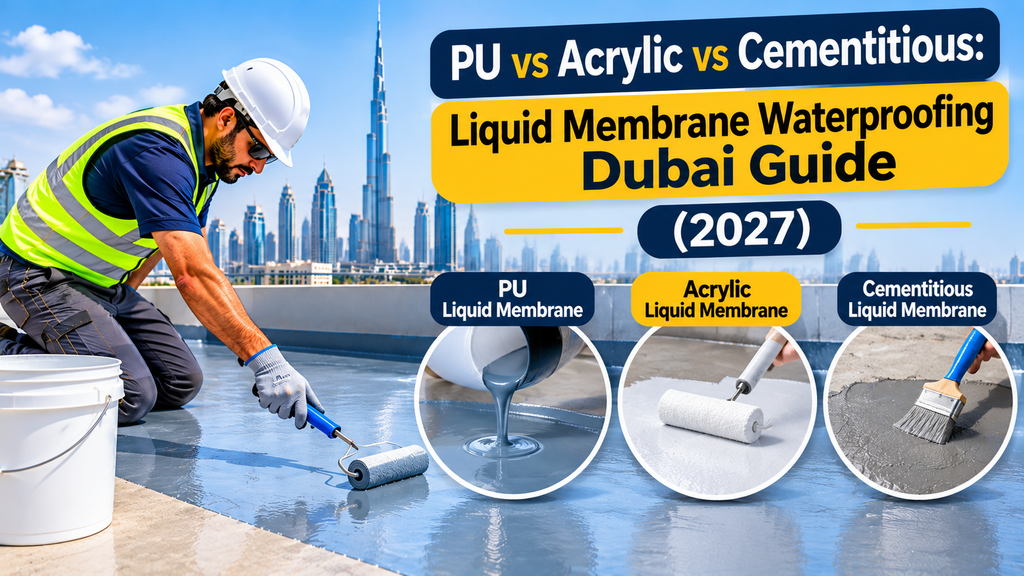
The table compares typical characteristics of each family. Individual products vary, so always check the manufacturer’s technical data for the product you’re considering.
| PU (polyurethane) | Acrylic | Cementitious | |
| Main composition | Polyurethane resin | Water-based acrylic polymers | Cement plus additives, often polymer-modified |
| Flexibility | Typically elastic | Typically flexible | Rigid to flexible, depending on formulation |
| Crack bridging | Often good for fine cracks, product-dependent | Varies; often needs reinforcement | Limited in rigid types; better in flexible types |
| UV exposure | Some types need a UV-resistant topcoat | Many roof products are designed for exposure | Often needs protection on exposed roofs |
| Ponding water | Many products tolerate it; check the data sheet | Varies widely; some are not suitable | Product-dependent |
| Substrate | Primed concrete, screed, some existing coatings | Suitable roof surfaces and some existing coatings | Concrete and masonry |
| Application | Brush, roller or spray; primer required | Brush, roller or spray; reinforcement at details | Brush or trowel; may need damp curing |
| Preparation | Clean, dry, sound, primed | Clean, sound, primed as specified | Clean, sound, often pre-dampened |
| Maintenance | Topcoat renewal on exposed roofs | Periodic recoating | Protection layer upkeep |
| Typical roof use | Flat roofs, terraces, complex details | Exposed roof coatings on well-drained roofs | Concrete roofs and podiums, often covered |
| Key limitation | UV and moisture sensitivity of some types | Ponding and immersion limits of some types | Limited flexibility in rigid types |
Which Liquid Membrane Is Best for Dubai Roofs?
There’s no single best waterproofing membrane for every Dubai roof. The right choice depends on the roof’s condition, substrate, drainage, exposure and movement.
- PU waterproofing: consider it for roofs that need a flexible membrane and good detailing around penetrations. On exposed roofs, use a UV-stable system or a UV-resistant topcoat.
- Acrylic waterproofing: consider it for suitable exposed roofs with good drainage, especially where a reflective coating is wanted. Check the manufacturer’s limits on ponding water and its maintenance schedule.
- Cementitious waterproofing: consider it for compatible concrete surfaces, often under screed or tiles, where the chosen formulation meets the exposure and movement requirements. Exposed roofs may need an extra protective layer.
Examples:
- A villa roof with AC units, pipes and a parapet might suit a reinforced PU system with a UV-resistant topcoat.
- A well-drained exposed roof on a low-rise building might suit a reflective acrylic coating rated for the conditions.
- A concrete podium due to be tiled might use a flexible cementitious membrane under the screed.
That’s why every liquid membrane waterproofing Dubai job should start with an on-site inspection. It reveals ponding areas, cracks, the state of the existing waterproofing and what the roof actually needs.
How Liquid Membrane Waterproofing Is Applied on Roofs
- Inspect the roof and identify existing leaks.
- Check the substrate and existing waterproofing.
- Remove loose coatings, dirt and contaminants.
- Repair cracks and damaged areas with suitable materials.
- Prepare the surface and apply the specified primer.
- Treat joints, corners, outlets and penetrations.
- Apply the membrane at the specified thickness.
- Add reinforcement where the system requires it.
- Allow it to cure according to the manufacturer.
- Apply a protective topcoat if required.
- Inspect the completed system.
- Carry out a water or flood test where suitable and safe.
The exact method differs between PU, acrylic and cementitious systems, so the manufacturer’s procedure always takes priority.
Common Roof Waterproofing Problems in Dubai
- leaks after rainfall
- cracks in old waterproofing
- peeling or blistering coatings
- ponding water on flat roofs
- leaks around drainage outlets
- failed joints and penetrations
- worn protective coatings
- membranes applied too thin
- poor surface preparation
- the wrong product for the exposure
A new coating over an unknown problem rarely lasts. Proper leak detection in Dubai finds where water actually enters before repairs begin.
How Much Does Liquid Membrane Waterproofing Cost in Dubai in 2027?
There’s no reliable single price for liquid membrane waterproofing Dubai projects, because every roof is different. The main cost factors are:
- roof area and access
- the condition of the existing waterproofing, and whether it must be removed
- surface preparation
- crack and joint repairs
- membrane type and specific product
- number of coats and specified thickness
- primer and reinforcement
- protective topcoat
- labour and equipment
- testing and inspection
PU systems with UV topcoats, reinforced acrylic systems and cementitious systems with protective layers each add different steps, which affects the price. Ask for an itemised quote showing materials, preparation, repairs, coats, thickness and topcoat separately, so you can compare like with like.
Common Mistakes When Choosing a Liquid Waterproofing Membrane
- choosing on price alone
- using an interior product on an exposed roof
- ignoring UV resistance
- applying over a wet or unsuitable surface
- ignoring cracks and joints
- overlooking drainage and ponding
- applying the membrane too thin
- skipping the specified primer
- not allowing enough curing time
- assuming all PU, acrylic or cementitious products perform the same
- coating over an existing layer without checking it first
Roof Waterproofing Considerations Across Dubai Communities
Every roof is different, even on the same street. These are general patterns, not rules:
- Villa communities such as The Springs, The Meadows, Arabian Ranches, Jumeirah Park, Emirates Hills and Jumeirah Islands often have flat concrete roofs with parapets, AC units and pipe penetrations, and some homes are 15+ years old. Detailing and ageing waterproofing are common concerns.
- Newer villa areas such as Dubai Hills may still be under developer warranty. Check that before changing a roof system.
- Waterfront homes on Palm Jumeirah and in Jumeirah see strong sun, wind and salt-laden air, so the exposure rating of the membrane matters.
- High-rise and mid-rise buildings in Dubai Marina, Downtown Dubai, Business Bay and Meydan have large roofs, podiums and plant areas, where building management approval and access planning are part of the job.
- Mixed residential areas such as Al Barsha, JVC, JVT, Silicon Oasis and Motor City include townhouses, low-rise buildings and terraces, where drainage and ponding are often the deciding factors.
For apartment balconies and roof terraces, see our terrace waterproofing in Dubai service, and for whole-villa protection see villa waterproofing.
How to Choose a Roof Waterproofing Company in Dubai
When comparing waterproofing contractors in Dubai, check:
- experience with roof waterproofing
- knowledge of PU, acrylic and cementitious systems
- a proper roof inspection before quoting
- product selection matched to exposure and substrate
- manufacturer-approved application methods
- surface preparation and crack repair included
- a clear quotation and scope of work
- thickness checks and quality control
- relevant project experience
- testing and after-service support
Waterproofing Dubai offers roof waterproofing services along with wider waterproofing solutions for residential properties. The team uses thermal imaging and moisture testing to locate leak sources, flood-tests before handover, and provides an itemised written quotation after a site inspection.
Liquid Membrane Waterproofing Dubai: FAQs
What is liquid membrane waterproofing?
It’s a liquid coating applied to a roof or other surface that cures into a continuous, seamless waterproof layer.
Which is better for Dubai roofs: PU or acrylic waterproofing?
Neither is better everywhere. PU suits roofs that need a flexible membrane and complex detailing; acrylic suits suitable well-drained exposed roofs. The right choice depends on the roof and the specific product.
Is cementitious waterproofing suitable for exposed roofs?
Some formulations are; many are better used under screed, tiles or a protective coating. Check that the product is rated for exposed roof use.
How long does a liquid waterproofing membrane last?
It depends on the product, thickness, exposure, detailing and maintenance. Exposed systems usually need periodic topcoat renewal. Ask your contractor for the warranty on the specific system.
Can PU waterproofing withstand Dubai’s summer temperatures?
Suitable PU systems are used on Dubai roofs, but some need a UV-resistant topcoat for exposure. Application must follow the manufacturer’s temperature limits.
Is acrylic waterproofing suitable for roofs with standing water?
Not always. Ponding resistance varies widely between acrylic products. Fix drainage where possible and choose a product rated for ponding.
Can liquid membrane waterproofing be applied over existing waterproofing?
Sometimes, if the existing layer is sound, well bonded and compatible. Failed or incompatible layers must be removed first.
How much does liquid membrane waterproofing cost in Dubai in 2027?
It depends on area, condition, preparation, repairs, system, thickness and topcoat. Get an itemised quote after an inspection.
How is a liquid waterproofing membrane applied to a roof?
The surface is inspected, cleaned, repaired and primed. Details are treated, the membrane is applied at the specified thickness with reinforcement where needed, then cured, protected and tested.
How do I choose the right roof waterproofing system for my property?
Start with a professional roof inspection, then choose a system rated for your roof’s exposure, substrate, drainage and movement.
Conclusion:
PU, acrylic and cementitious membranes all have a place on Dubai roofs. PU offers flexibility, acrylic offers convenient and often reflective coatings, and cementitious systems bond well to concrete. But none is best for every roof. Successful liquid membrane waterproofing Dubai projects depend on the roof’s condition, substrate, drainage and exposure, the right product, and careful application. Start with an inspection, and choose a contractor who explains why a system suits your roof.
Book a Roof Waterproofing Inspection
Worried about roof leaks or an ageing membrane? Contact our waterproofing team to book a site inspection and receive an itemised quotation for your roof.

Keep reading

Can You Waterproof Over Existing Floor Tiles? Transparent Coating vs Re-tiling (2027 Blog)
If water is leaking in your home, whether from ceiling staining on the balcony, wet grout in the shower, or water entering…
Read article Can You Waterproof Over Existing Floor Tiles? Transparent Coating vs Re-tiling (2027 Blog)
Building Roof Waterproofing for Towers & Podium Decks: Systems Compared (2027 Blog)
If building roof waterproofing in Dubai fails on the roofs or podium decks of buildings, it can cause problems in the areas…
Read article Building Roof Waterproofing for Towers & Podium Decks: Systems Compared (2027 Blog)
Villa Roof Waterproofing in Dubai
A practical guide for Dubai villa owners: how roofs fail, which waterproofing system fits your roof, how the work should be done,…
Read article Villa Roof Waterproofing in Dubai