
In this article
- Villa Roof Waterproofing Dubai: Why New Doesn’t Always Mean Defect-Free
- Why Villa Roof Waterproofing Inspection Matters Before Handover
- Waterproofing Layers on a Villa Roof: What’s What
- Villa Roof Waterproofing Dubai: What Should Be Checked Before Handover?
- New Villa Roof Waterproofing Checklist for Buyers
- What Waterproofing Tests Should Be Requested Before Villa Handover?
- Waterproofing Documents to Collect Before Accepting a New Villa
- Pre-Handover Waterproofing Checks for Emaar, Nakheel and Meraas Villas
- Common Roof Waterproofing Defects Found During New Villa Inspections
- What to Do If Waterproofing Defects Are Found Before Handover
- Should You Hire an Independent Roof Waterproofing Inspector in Dubai?
- Villa Roof Waterproofing in Dubai’s Climate
- Villa Roof Waterproofing Checks Across Dubai Communities
- How Much Does a Pre-Handover Roof Waterproofing Inspection Cost in Dubai?
- Frequently Asked Questions:
- Final Thoughts on Villa Roof Waterproofing Before Handover
A new villa may look perfect at handover, but hidden roof waterproofing issues can still cause problems after the first heavy rain. Poorly sealed joints, damaged membranes or blocked drainage can allow water to enter and affect ceilings, walls and interior finishes. Villa roof waterproofing Dubai inspections help homeowners identify these hidden concerns before moving in, giving them the opportunity to document defects and request repairs while the developer’s handover process is still active.
Villa Roof Waterproofing Dubai: Why New Doesn’t Always Mean Defect-Free
Collecting the keys to a brand-new villa feels like the end of the process. But new construction can still hide waterproofing problems: a membrane damaged by other trades, a drain set slightly too high, an AC plinth that was never properly sealed. Most of these stay invisible until the first heavy rain, when a stain appears on a bedroom ceiling.
That’s why villa roof waterproofing Dubai buyers should treat the roof as a dedicated part of the pre-handover inspection, whether the villa comes from Emaar, Nakheel, Meraas or another developer. Each developer has its own handover process, and the time to record visible defects is while that process is still open.
This guide explains what to look at on a new villa roof, which tests and documents to ask about, how to record defects through the developer’s official channels, and when an independent specialist is worth involving.
Why Villa Roof Waterproofing Inspection Matters Before Handover
- Protecting ceilings and finishes: roof leaks damage ceilings, paint, joinery and electrical fittings below.
- Spotting incomplete membrane work: gaps, missing upturns or damage from other trades.
- Checking drainage: water should flow to outlets, not sit on the roof.
- Finding defects at penetrations: pipes, conduits, AC bases and tank supports are common weak points.
- Avoiding disruption later: fixing a roof after you’ve moved in and furnished is harder.
- Using the handover window: observations are easiest to raise while the developer’s snagging process is active.
A general snagging list often focuses on interior finishes. The roof deserves its own attention because problems there are hidden, slow to show and expensive to trace later.
Waterproofing Layers on a Villa Roof: What’s What
Before inspecting, it helps to know the layers. Exact build-ups vary by project and specification, but a typical flat roof can include:
- Waterproofing membrane: the layer that actually keeps water out, such as a bituminous sheet or liquid-applied membrane.
- Thermal insulation: boards that reduce heat transfer into the villa. Insulation is not waterproofing.
- Screed: a cement layer, often laid to falls so water runs to drains.
- Protective finish: tiles, pavers or a coating that protect the layers below from sun, foot traffic and damage.
On many finished roofs the membrane is hidden under screed and tiles, so you’ll mostly see the protective layer, edges, upturns and details.
Villa Roof Waterproofing Dubai: What Should Be Checked Before Handover?
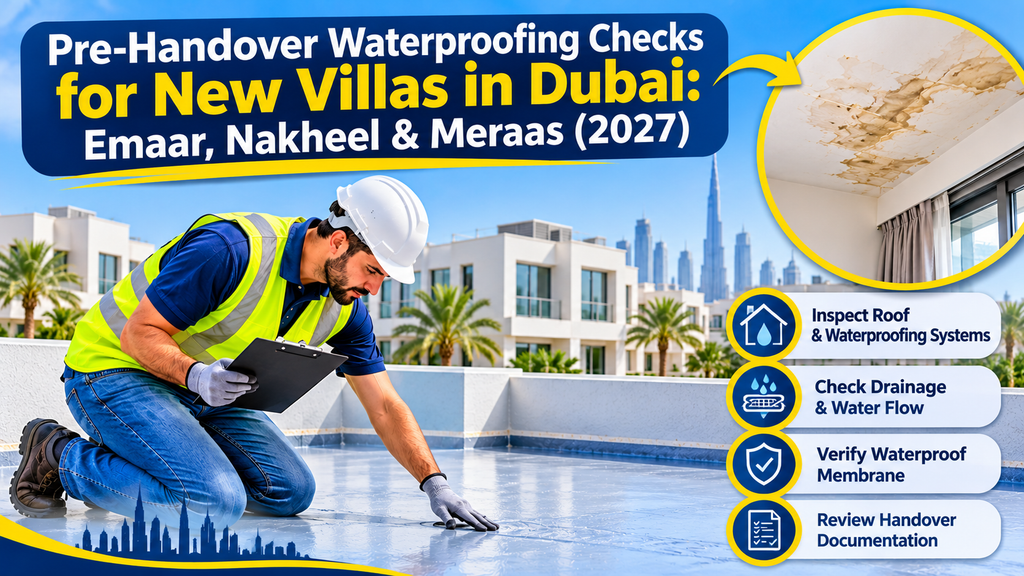
Safety first: only access the roof where the developer allows it, using the provided access, and never walk on fragile surfaces, near unprotected edges or in extreme heat. Don’t lift tiles, cut materials or run your own water tests.
Roof waterproofing membrane condition
Where the membrane is visible, look for:
- tears and punctures
- open or poorly finished seams
- bubbles or blisters
- peeling or detached areas
- gaps in coverage
- damage from construction activity, such as dropped tools or equipment scrapes
Where the membrane is concealed, visual checks can’t confirm its condition.
Roof parapets and waterproofing upstands
- how the membrane finishes at parapet walls
- whether upturns are continuous
- corners and junctions
- visible cracks or gaps
- sealant condition
- whether membrane edges are protected, for example by a flashing or capping
Roof drains and rainwater outlets
- are drain outlets visible and accessible?
- are covers and grates fitted?
- any debris, cement waste or sand blocking them?
- do connections look complete?
- do the surrounding surfaces slope towards them?
- are there stains or marks showing water has stood nearby?
Roof falls and water ponding
A roof should direct water to its outlets. Look for incorrect falls, low spots, uneven screed and water trapped around equipment. A little water shortly after rain isn’t automatically a defect; persistent ponding, or water collecting away from the drains, is worth recording and asking about against the project specification.
AC bases, water tank bases and service penetrations
Check around:
- AC plinths
- water tank supports
- pipe sleeves
- electrical conduits and cable entries
- solar supports, where fitted
The membrane should run continuously up and around these, with properly sealed junctions. Gaps, open sleeves or unsealed fixings are common snags.
Roof tiles, screed and protective layers
- cracked or loose tiles
- damaged screed
- unfinished protective finishes
- exposed membrane areas
- rough or unfinished edges
- signs of water under the finish, such as staining or efflorescence at joints
A cracked tile or screed is a damaged protective layer, not necessarily a membrane failure, but it should still be recorded.
New Villa Roof Waterproofing Checklist for Buyers
- Roof surface looks complete and free from visible damage
- Accessible membrane areas show no obvious tears or open seams
- Parapet upstands and terminations look properly finished
- Roof drains and outlets are accessible and clear
- Falls direct water towards the drains
- No unexplained persistent ponding
- AC bases and pipe penetrations are properly detailed
- Water tank bases and service supports checked
- Screed and protective finishes are complete
- Roof-to-wall junctions have no obvious gaps
- Waterproofing test records requested
- Material and system documentation requested
- Waterproofing warranty documents collected
- Visible defects photographed and recorded
This is a visual and document-review checklist. It doesn’t replace specialist testing or a technical inspection.
What Waterproofing Tests Should Be Requested Before Villa Handover?
Roof flood testing
A flood test temporarily holds water on a roof area to check whether the waterproofing lets any through. It typically involves:
- temporarily blocking or managing the drains in line with the approved method
- filling the area with water as specified
- checking the ceilings and spaces below during the test
- recording the results
The test must follow the project specification, approved method statement and specialist instructions, including drainage and overflow arrangements, because water held on a roof adds load and can overflow. Test duration and water depth aren’t universal. Buyers shouldn’t run their own flood tests; ask whether one was carried out and request the record where the specification required it.
Membrane inspection and seam checks
During construction, membranes are normally inspected before being covered: seams and overlaps, continuity, termination details and installation to the manufacturer’s requirements. Ask whether inspection records exist for your roof.
Moisture detection and further investigation
Where you see staining, damp or other signs of a concealed problem, moisture meters and thermal imaging can help locate wet areas. They are diagnostic aids that show where to investigate further, not standalone proof that a waterproofing system has passed or failed.
Waterproofing Documents to Collect Before Accepting a New Villa
Subject to your handover package and project specifications, ask for or keep:
- waterproofing system specifications
- product technical data sheets
- manufacturer details
- installation or inspection records
- flood-test reports, where performed
- approved drawings and relevant as-built drawings
- material conformity documents, where applicable
- waterproofing warranty documents
- maintenance and operation instructions
- records of any defect rectification
If a leak appears after you move in, these records help any contractor understand what was installed, and help you discuss the issue with the developer.
Pre-Handover Waterproofing Checks for Emaar, Nakheel and Meraas Villas
Each developer runs its own process, and procedures can change. Always follow the instructions in your handover notice and check the developer’s current official information. Your sale and purchase agreement, project documents and applicable regulations set the actual requirements, including any defects liability terms.
Emaar villa handover and roof waterproofing inspection
Emaar’s published factsheet describes a Home Orientation as a first tour of the property once it’s near completion, during which any observations needing attention are noted. It states that observations are recorded and a copy of the checklist is emailed to the owner, and that each property is eligible for one orientation before handover.
For the roof:
- prepare your roof observations before the visit, since there’s typically one orientation
- ask whether roof access is possible during the orientation
- make sure every roof observation is on the emailed checklist
- ask about waterproofing test records
- keep copies of the checklist and any rectification confirmations
Emaar’s defect liability factsheet also notes that cosmetic surface damage from construction should be notified at the Home Orientation, so record visible damage then.
Nakheel villa handover and roof waterproofing inspection
Nakheel’s handover FAQs say the owner receives an email when the property is ready for home orientation, the visit lasts one hour, and only one home orientation is allowed per unit. Owners can appoint an authorised representative or ask Nakheel to carry out the orientation on their behalf, and a before-and-after report is shared to confirm completion of snags.
For the roof:
- plan your roof checks to fit the one-hour visit
- if you can’t attend, brief your representative on the roof checklist
- record visible roof defects during the orientation
- check the before-and-after report covers each roof item
- request clarification in writing on anything unresolved
Meraas villa handover and roof waterproofing inspection
We couldn’t find current published details of Meraas’s villa handover procedure, so follow the instructions in your Meraas handover notice. In general:
- review the handover instructions you receive
- compare the finished roof against the agreed specifications
- check accessible roof and drainage details
- document defects and ask for clarification in writing
- report through Meraas’s formal procedure
Common Roof Waterproofing Defects Found During New Villa Inspections
- incomplete membrane coverage
- poorly sealed membrane joints
- weak terminations at parapets
- damaged membrane around AC bases
- inadequate falls to drains
- blocked roof outlets, often with construction debris
- poorly sealed pipe penetrations
- cracked protective screed
- incomplete waterproofing around water tank supports
- construction damage to exposed waterproofing
Not every visible defect will cause a leak, but each is worth recording so the developer can assess and rectify it.
What to Do If Waterproofing Defects Are Found Before Handover
- Photograph the area clearly, with a wide shot and a close-up.
- Record the exact roof location, such as “north-east corner, next to the AC plinth”.
- Describe what you see without guessing the cause, for example “open seam in membrane at parapet”.
- Add it to the developer’s official snagging or home-orientation report.
- Ask for written confirmation of the proposed rectification.
- Where applicable, ask for test or inspection evidence after repair.
- Reinspect before treating the item as closed.
- Keep copies of reports, emails and documents.
Don’t carry out your own repairs or modifications before handover: unauthorised work can complicate responsibility for the roof and any developer warranty.
Should You Hire an Independent Roof Waterproofing Inspector in Dubai?
Independent help is worth considering when:
- the roof is large or complex
- there are many penetrations and installations
- you can see membrane damage
- drainage looks poor
- water ponds without explanation
- test records are missing or unclear
- defects return after developer rectification
- you want an independent technical opinion
A useful report includes photographs, clear observations, marked defect locations and recommended next steps, separating observations from suspected and confirmed defects. Waterproofing Dubai offers roof leakage inspection with moisture testing and thermal imaging to support that process.
Villa Roof Waterproofing in Dubai’s Climate
- high roof temperatures stress membranes, sealants and coatings
- strong UV degrades exposed materials not designed for it
- thermal movement works on joints and terminations
- occasional heavy rain tests drainage that may sit unused for months
- dust and sand block drains and outlets
- AC maintenance visits can damage membranes and finishes around plant
- exposed coatings and sealants need periodic checks
The waterproofing system should be selected and installed to suit the roof design, exposure, substrate and manufacturer requirements. Explore more on waterproofing membrane systems.
Villa Roof Waterproofing Checks Across Dubai Communities
Roof layout, terraces, equipment placement and drainage vary from villa to villa, even within the same community, so these are general pointers rather than known issues.
- Emaar communities such as Arabian Ranches, Arabian Ranches 2, Arabian Ranches 3, The Springs, The Meadows and Emirates Hills, and Dubai Hills Estate (an Emaar and Meraas development), include many villas with flat roof areas housing AC units and water tanks.
- Nakheel communities such as Palm Jumeirah, Jumeirah Park, Jumeirah Islands and Al Furjan range from waterfront homes to family villas; coastal exposure on Palm Jumeirah makes sealants and metal fixings worth closer attention.
- Other developments such as DAMAC Lagoons, DAMAC Hills, DAMAC Hills 2, Tilal Al Ghaf, Al Barari and Mudon come from other developers with their own handover processes; the same roof checks apply.
Villas with roof terraces, pergolas, planters or solar panels have more penetrations and details to check than plain service roofs.
How Much Does a Pre-Handover Roof Waterproofing Inspection Cost in Dubai?
We couldn’t find reliable, current AED prices for roof-specific pre-handover inspections, so we’re not quoting rates. Cost depends on:
- roof area and access
- number of roof sections and terraces
- complexity of details
- specialist equipment needed
- moisture investigation
- testing and reporting scope
- whether further technical assessment is needed
Levels of service: a general visual inspection is quickest; specialist testing adds equipment and time; a full waterproofing assessment includes investigation, reporting and recommendations. Ask what’s included before booking.
Frequently Asked Questions:
Should I inspect roof waterproofing before taking handover of a new villa?
Yes, where the developer allows roof access. Recording visible defects during the handover process is simpler than raising them after you move in.
What should I check on a new villa roof in Dubai?
Visible membrane areas, parapet upturns, drains, falls and ponding, AC and tank bases, pipe penetrations and the protective finish.
How do I know if a new villa roof has waterproofing defects?
Visible signs include open seams, damaged membrane, blocked drains, ponding and ceiling stains. Concealed defects need specialist investigation.
What is a roof flood test before handover?
A controlled test holding water on the roof to check for leaks below. It must follow the approved method; ask the developer whether one was done.
Should I ask the developer for a waterproofing test report?
Yes. Ask whether testing was carried out and request records where the project specification required them.
Can roof waterproofing defects be fixed before handover?
Recorded defects are typically reviewed and rectified through the developer’s snagging process. Ask for written confirmation and reinspect.
Do Emaar, Nakheel and Meraas follow the same villa handover process?
No. Each has its own procedure. Follow your handover notice and check current official information.
Can I hire an independent waterproofing inspector before handover?
Many buyers do, subject to the developer’s access rules. Check what access is allowed and arrange it in advance.
What documents should I collect for villa roof waterproofing?
Specifications, data sheets, test and inspection records, drawings, warranty documents and maintenance instructions, where available.
What should I do if a roof leak appears after handover?
Photograph it, report it promptly through the developer’s service request channel, and check your warranty documents. Avoid opening up the roof yourself.
Final Thoughts on Villa Roof Waterproofing Before Handover
The most important pre-handover roof checks are the membrane where visible, parapet upturns, drains, falls, and every penetration from AC bases to pipe sleeves. Record defects through the developer’s official process, keep every document, and remember that a visual check can’t confirm a concealed membrane. Good villa roof waterproofing Dubai owners can rely on is documented as well as installed.
Buying a new villa and want a second opinion on the roof? See our villa waterproofing services, roof leakage repair solutions and wider waterproofing services in Dubai, or contact our team to book a roof inspection.

Keep reading
Top Causes of Roof Leakage in Dubai | Waterproofing Guide
Roof leakage is one of the most common and costly problems faced by property owners across Dubai and the UAE. Whether it…
Read article Top Causes of Roof Leakage in Dubai | Waterproofing Guide
Swimming Pool Waterproofing in Dubai: Complete Guide
Swimming pools in Dubai face constant stress from heat, chemicals, and ground movement. Without proper waterproofing, even a small defect can lead…
Read article Swimming Pool Waterproofing in Dubai: Complete Guide
Cost of Waterproofing in Dubai: Walls, Roof & Pools
Waterproofing is one of the most important investments for property owners in Dubai. Whether it’s damp walls, roof leakage, or pool seepage,…
Read article Cost of Waterproofing in Dubai: Walls, Roof & Pools