
In this article
- Summary:
- What is a mesh-reinforced waterproof membrane?
- How does mesh reinforcement support liquid waterproofing?
- Fully or partially reinforced?
- Mesh Reinforced or Standard Liquid Membrane Waterproofing?
- Benefits of Mesh Reinforced Waterproofing
- Benefits and Limitations of Standard Liquid Membranes
- When is Mesh Reinforcement Worth it?
- Where is Mesh Reinforced Waterproofing Typically Used?
- Fiberglass and Polyester Mesh
- Step-by-Step: Installing a Mesh-Reinforced Liquid Membrane
- Common Mistakes When Installing Reinforcement Mesh
- How Dubai’s Climate and Building Conditions Affect System Selection
- Factors Affecting Mesh Waterproofing Costs in Dubai
- Choosing the Best Waterproofing System for your Property
- Why Use Professionals for Inspection & Application
- FAQs
- Conclusion:
- Speak to Waterproofing Dubai to Choose the Right System
Mesh is often used in Waterproofing in Dubai. It can be applied to corners, round pipework and other features in order to create a reinforced waterproof membrane from standard waterproofing membranes. It is often key in making waterproof membranes last, avoiding cracking in vulnerable spots.
However, is mesh necessary for all roofs, balconies and bathrooms? Or can a standard liquid membrane be sufficient in some applications? This article will provide you with simple information to help you decide on the best option. The guide is intended to help developers, contractors, facility managers, property managers, agents, inspectors and property owners in Dubai understand where mesh can be beneficial and where a good standard liquid membrane may be sufficient. If you are comparing different mesh waterproofing Dubai solutions, getting multiple quotes or regularly specifying waterproofing work, this guide can help you make a more informed decision.
Summary:
Reinforced mesh should be used in corners, raised edges, cracks, join details, penetrations, drainage, and surfaces with thermal movement. It is often included within full waterproofing systems over fully exposed areas, including roofs, terraces and balconies. Adding mesh throughout gives increased strength, uniform thickness and can improve resistance to cracking and tearing.
A standard liquid membrane can perform well in good conditions (stable and well prepared surfaces) with local mesh reinforcement. A mesh membrane is not a standalone waterproofing system, and may not be necessary. Choosing the correct waterproofing system depending on surface, exposure and manufacturer specifications is key.
What is a mesh-reinforced waterproof membrane?
A mesh-reinforced waterproof membrane uses mesh throughout a liquid membrane. The mesh is inserted into wet membranes, and the membrane is applied over to fully encapsulate the mesh. This creates a solid waterproof membrane, with reinforcement similar to steel in concrete.
The meshes commonly used are:
Fiberglass mesh – Woven glass fibre scrim. Often alkali resistant if used in cementitious systems.
Polyester – Non-woven or woven polyester felts. Often used in flexible liquid membranes.
Depending on the chemical type of membrane (polyurethane, acrylic, cementitious, hybrid etc.), different mesh will be best suited.
What is a standard liquid waterproofing membrane?
A standard liquid membrane is applied by brushing, rolling, trowelling or spraying in 1 or more coats. There is no mesh throughout the full area. Once cured, this forms a seamless membrane.
Many different liquid membranes can be applied in this way. As long as the correct thickness is applied and the material is suitably flexible, small cracks and movement in the surface can be overcome. However, in general it is common for local mesh reinforcement to be recommended in corners, joins, cracks and penetrations.
How does mesh reinforcement support liquid waterproofing?
Mesh adds strength in a few practical ways:
- Spreads stress. When a crack opens or a corner moves, the fabric spreads the strain over a wider area instead of letting it concentrate in one thin spot.
- Improves tear and puncture resistance, which helps on roofs with foot traffic and equipment.
- Helps control thickness. The fabric acts as a guide, making it easier to build an even layer and harder to leave thin patches.
- Holds the membrane together across changes in direction, such as wall-to-floor junctions, upstands and around pipes.
- Bridges cracks better, particularly where hairline cracks may widen slightly with temperature changes.
Fully or partially reinforced?
Fully reinforced: Mesh is included throughout the membrane, with overlaps between mesh strips. This is often used on fully exposed areas such as roofs, terraces, balconies and podiums where the whole surface is exposed to thermal movement, foot traffic and heat.
Partially reinforced: Mesh is included at key details, such as corners, raised edges, cracks, drainage, penetrations and joins. The main body of waterproofing is a standard thickness liquid membrane.
Both options can be correct choices depending on the system, surface, exposure and manufacturer specifications.
Not a standalone waterproof system
Mesh on its own is not a waterproof system. It must be fully encapsulated in a compatible membrane, applied to a correctly prepared and primed surface, to the correct thickness, and cured. If mesh is applied to a dry membrane, left exposed, or used with the incorrect product it can create weak points in the waterproofing.
Mesh Reinforced or Standard Liquid Membrane Waterproofing?
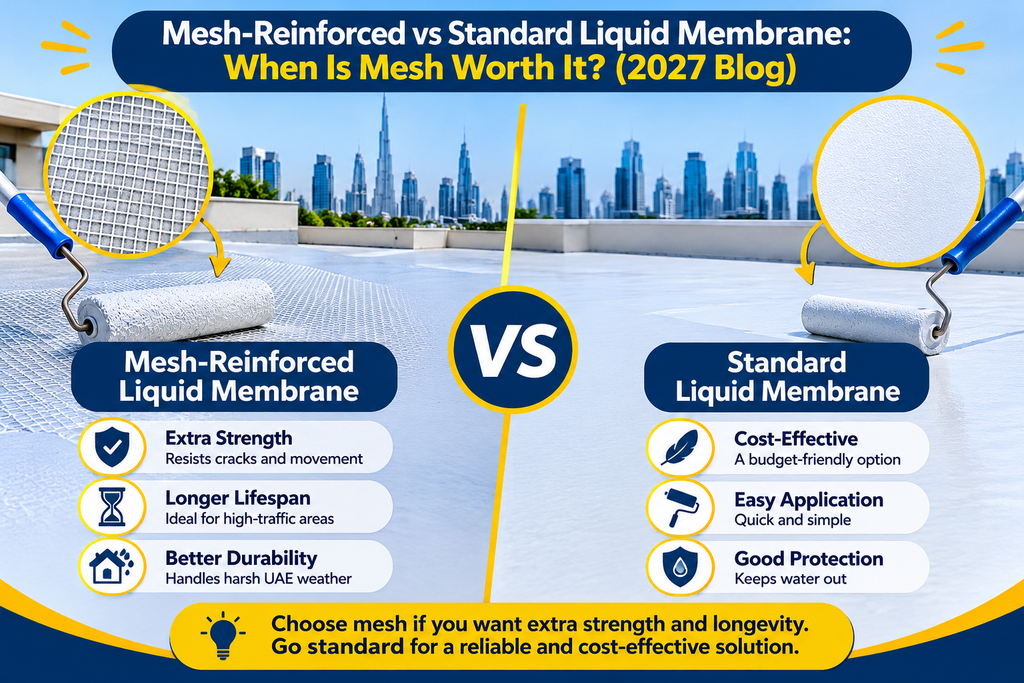
| Factor | Mesh-reinforced liquid membrane | Standard liquid membrane |
| Build-up | Liquid coats with reinforcement fabric embedded | Liquid coats only, with local reinforcement at details where specified |
| Crack bridging | Generally improved, especially over moving or cracked substrates | Depends on the material’s own flexibility and thickness |
| Tear and puncture resistance | Generally higher | Generally lower; depends on the product |
| Thickness control | Easier to achieve an even build | Relies more on applicator skill and wet-film checks |
| Corners and junctions | Strong, continuous reinforcement through changes in direction | Needs careful detailing; local reinforcement usually recommended |
| Installation time and labour | More steps, more labour | Faster to apply |
| Material cost | Higher (fabric plus extra membrane to encapsulate it) | Lower |
| Best suited to | Exposed roofs, terraces, balconies, podiums, cracked or older substrates | Sound, stable, protected surfaces; areas under tiles or screed where specified |
Benefits of Mesh Reinforced Waterproofing
- Increased resistance to cracking from expansion/contraction in concrete, and fine cracks.
- Increased strength in key details (corners, raised edges, drainage and pipework), reducing likelihood of leaking.
- More uniform thickness, reducing the risk of thin spots.
- Improved durability where there is foot traffic (often on roofs with access for AC technicians).
- Can be useful on older roofs, with imperfect substrates.
- Added confidence in areas that are exposed and subject to large temperature fluctuations.
Benefits and Limitations of Standard Liquid Membranes
Benefits
- Quick/easy to apply to large simple areas.
- Lower costs (material & labour).
- Seamless and suitable for complex shapes.
- Suitable for many protected areas (such as under tiles in moist areas) where the substrate is in good condition.
- Easy to inspect and recoat in exposed applications.
Limitations
- Requires greater skill to achieve uniform thickness.
- Less resistant to cracking/movement in substrates, depending on the product.
- Weaker within details if local reinforcement is omitted.
- Less resistant to puncturing and wear from foot traffic depending on product and top coat.
When is Mesh Reinforcement Worth it?
Full or local mesh reinforcement is generally worth including in the following situations:
- High exposure to direct sunlight and daily thermal movement (roofs/terraces)
- Cracked substrates, or signs of movement
- Old roof being refurbished with imperfect substrate
- Lots of details (AC plinths, pipework, skylights, drainage, parapets & raised edges)
- Likely to have foot traffic from maintenance
- It is required by the manufacturer’s system specification.
- Hard to access in future (podium decks under landscaped areas for instance). Getting this right the first time is very important.
A standard liquid membrane (with local reinforcement) may be sufficient in the following situations:
- New in good condition substrates
- Protected areas (under tiles/screed/other materials)
- Small and simple areas with few penetrations
- Product is specifically designed and specified for un-reinforced use in this application.
In short, mesh reinforcement is recommended in high stress, movement, exposure or complexity situations. However, for stable, protected and simple applications, as long as it is applied correctly with reinforced details, it may not be as important.
Where is Mesh Reinforced Waterproofing Typically Used?
Roof / Terraces
Exposed roofs and terraces are where waterproofing mesh for roofs earns its place. Daily heat cycles, UV and foot traffic all stress the membrane. Villa roofs and large terraces in Emirates Hills, Jumeirah Islands and Jumeirah Park often have big flat areas plus parapets, skylights and AC equipment, so full-area reinforcement or heavy detail reinforcement is common. Our roof waterproofing services in Dubai page explains how roof systems are assessed.
Concrete Roofs
Within concrete roofs, reinforced liquid waterproofing systems can be used to improve bridging of the fine cracks that often form in older concrete slabs and screeds. Many established villa communities (such as Arabian Ranches, The Springs & The Meadows) have original concrete roofs requiring renovation. Applying mesh reinforced waterproofing over well-repaired substrates is often a good solution.
Balconies
Despite their size, balconies can be difficult to waterproof. They can be exposed to direct sunlight, water from cleaning and movement in the edges and door thresholds. In residential towers (Dubai Marina, Business Bay & Downtown Dubai) leaks in balcony waterproofing can quickly impact the unit below. Therefore, mesh reinforcement in raised edges, door thresholds and drainage is extremely valuable.
Podium decks
Podium decks within mixed use/ residential buildings (Downtown Dubai, Dubai Marina & Palm Jumeirah) are often above car parks, retail areas or lobbies. Due to the nature of these areas, the waterproofing system is often hidden beneath landscaping, paving or pools, making it very disruptive to repair. Having mesh reinforcement within the waterproofing system can help with the stress from foot traffic during installation, and long term stress in drainage, planters and joins.
Bathrooms / Moist Areas
Within bathrooms, kitchens and laundries, the waterproof membrane is generally protected by screed and tiles. Many systems will not include full mesh reinforcement within these areas. However, mesh reinforcement is important in joins between walls/floors, corners of showers, drainage areas and pipework penetrations. Between tenancies, many refurbished apartments in JVC, JVT & Al Barsha have had correct detailing within wet areas to prevent leaking into the unit below.
Expansion joints/cracks
Mesh should NOT be used over expansion joints. Movement joints are designed to move (sometimes significantly). Although mesh in liquid waterproofing can be used to reinforce fine static cracks and slight movement, it is not designed to accommodate movement in structural expansion joints. Proper movement joint solutions must be used (flexible joint tapes, correct sealant and backing material) and detailed appropriately as per manufacturer instructions.
If there are fine non/mildly moving cracks, it is common to repair the crack, and then apply a reinforced strip of membrane over the cracks before applying the main coats.
Corners, Edges & Pipework Penetrations
Corners, edges, raised edges, parapets and pipework penetration points are likely locations for failure in liquid waterproofing membranes. Even in systems where mesh reinforcement is not used throughout the area, mesh reinforcement in these areas is widely recommended. Pre-formed mesh (with correct overlaps) around pipework and in corners can help create continuous waterproofing across changes in direction.
Commercial/mixed use buildings (Meydan, Dubai Silicon Oasis & Motor City) as well as family homes (Dubai Hills & Jumeirah) often have pipework for plant equipment, solar panels and services going through the roof.
Fiberglass and Polyester Mesh
Fiberglass and Polyester mesh cannot be interchanged. Different mesh types are best suited to different membrane types.
| Feature | Fibreglass mesh waterproofing | Polyester mesh waterproofing |
| Typical form | Woven glass-fibre scrim | Non-woven or woven polyester fleece or fabric |
| Behaviour | Strong and relatively stiff, with low stretch | Flexible and conformable, stretches with the membrane |
| Typical pairing | Often used with cementitious and some acrylic systems; alkali-resistant grades are used with cement-based products | Often used with flexible liquid membranes such as polyurethane and many acrylic systems |
| Strengths | Good dimensional stability and crack control in rigid or semi-rigid systems | Follows movement well and shapes easily around details |
| Watch-outs | Can be less forgiving where the membrane needs to stretch; needs full encapsulation | Must be compatible with the membrane and properly saturated |
The right choice depends on the membrane chemistry and the manufacturer’s system. Always use the reinforcement the membrane manufacturer specifies in its technical data sheet. Mixing products from different systems can lead to poor bonding, incomplete saturation or cracking. For more on membrane options, see our membrane waterproofing in Dubai page.
Step-by-Step: Installing a Mesh-Reinforced Liquid Membrane
Exact steps vary by product, so always follow the manufacturer’s technical data sheet. A typical sequence looks like this:
- Inspect the surface. Check for cracks, hollow areas, loose screed, damp, contamination and drainage problems. Identify movement joints.
- Prepare the substrate. Clean thoroughly, remove loose and weak material, grind or repair surfaces as needed, and make sure the surface is dry enough for the system.
- Repair cracks and form fillets. Repair cracks and create smooth fillets at wall-to-floor junctions, so the membrane doesn’t have to turn a sharp 90-degree corner.
- Treat movement joints separately with the appropriate joint system before or alongside the membrane, as specified.
- Apply primer suited to the substrate and membrane, and allow it to dry as required.
- Reinforce the details first. Apply membrane to corners, upstands, drains and penetrations, embed pre-cut mesh into the wet coat, and press it in fully.
- Apply the first coat across the field and, for fully reinforced systems, embed the mesh wet-on-wet, overlapping strips as the system specifies.
- Encapsulate the mesh with a following coat, so no fabric texture or fibres are exposed.
- Build to the specified thickness using further coats as required, checking wet-film thickness during application.
- Allow full curing before traffic, flood testing or covering, following the product’s curing guidance and the site conditions.
- Flood test or inspect where appropriate, then apply the top coat, protection screed, tiles or other finishes as specified.
Common Mistakes When Installing Reinforcement Mesh
- Laying mesh on a dry coat, so it never bonds properly and leaves voids
- Leaving the mesh exposed, with fibres poking through the top coat
- Insufficient overlaps between mesh strips, creating weak lines
- Wrinkles and air pockets trapped under the fabric
- Using the wrong reinforcement for the membrane type
- Bridging expansion joints with mesh instead of using a proper movement-joint system
- Skipping primer or surface preparation, leading to poor adhesion
- Applying too thin, assuming the mesh will make up for missing membrane thickness
- Ignoring curing conditions, such as applying in peak heat or on a damp substrate against the manufacturer’s guidance
- Rushing to cover or load the membrane before it has properly cured
How Dubai’s Climate and Building Conditions Affect System Selection
Dubai puts liquid waterproofing under real pressure:
- High surface temperatures and UV age exposed membranes and cause daily expansion and contraction. That favours flexible, UV-stable systems and reinforcement on exposed areas.
- Thermal movement opens and closes hairline cracks, which is where reinforcement helps most.
- Dust and sand settle on surfaces during application and must be cleaned off to get good adhesion.
- Humidity and dew, especially in early mornings, can affect application and curing for moisture-sensitive products.
- Occasional heavy rain tests every drain, upstand and junction at once.
- Busy rooftops with AC units, solar panels and maintenance traffic increase wear and the number of details.
- Fast-paced construction and refurbishment can tempt shortcuts in preparation and curing time, which experienced contractors avoid.
These conditions are a big reason why liquid applied waterproofing in Dubai is often specified with reinforcement on exposed roofs, terraces and balconies.
Factors Affecting Mesh Waterproofing Costs in Dubai
Costs vary by project, so it’s more useful to understand what drives them:
- Full vs partial reinforcement: full-area mesh uses more fabric, more membrane to encapsulate it and more labour.
- Membrane type: polyurethane, acrylic, cementitious and hybrid systems differ in material cost and number of coats.
- Surface condition: crack repairs, removing old layers, re-screeding and fillets add to the scope.
- Number of details: roofs crowded with pipes, plinths and drains take longer to detail.
- Area and access: large open roofs are more efficient per square metre; high-rise roofs and occupied buildings add logistics.
- Protection and finishes: top coats, screeds, tiles or traffic coatings on top.
- Testing and documentation: flood tests and inspections add time but reduce risk.
A site survey is the only way to get an accurate quote. Our waterproofing services page outlines the work we can assess.
Choosing the Best Waterproofing System for your Property
Ask these questions:
- Is the area exposed or protected? Exposed roofs, terraces and balconies usually benefit most from reinforcement.
- What’s the substrate condition? Cracks, previous repairs or movement point towards reinforced liquid waterproofing.
- How many details are there? Many penetrations and upstands favour reinforcement, at least locally.
- Will it be walked on or covered? Traffic and covered podiums need tougher systems.
- What does the manufacturer specify for this application?
- How easy will future repairs be? If access is hard, invest more in getting it right now.
Most good systems combine both approaches: full-area reinforcement where stress is high, and a well-applied standard membrane with reinforced details where conditions are stable.
Why Use Professionals for Inspection & Application
The difference between a durable waterproofing membrane and an early failing one is often down to careful consideration in inspection, preparation and detailing. Qualified waterproofing contractors can help with:
- Accurate assessment of substrate (cracks, dampness, old layers, drainage)
- Choosing if full or partial reinforcement is needed depending on exposure, movement and system requirements.
- Correct mesh reinforcement for membrane type, as specified by manufacturer.
- Correct detailing of expansion joints with movement joint solutions.
- Controlling thickness and curing.
- Testing before covering. Providing owners & facility managers with information on materials and methodology.
Whether you manage high rise buildings in Business Bay, a portfolio of villas in Arabian Ranches or apartment blocks in JVC, getting a good assessment in place before choosing your waterproofing system will save money and disruption in the future.
FAQs
What is mesh waterproofing?
Mesh waterproofing is a liquid membrane with reinforcement (either fibreglass or polyester) within. This provides extra strength, and increased resistance to tearing and cracking. It can also make it easier to get a uniform thickness.
Is mesh reinforced waterproofing better than standard liquid waterproofing?
Not necessarily. Reinfoced waterproofing tends to be stronger, and more resistant to cracking and movement. It is a good option for exposed roofs, terraces, balconies and podiums. However, with correct application, local mesh details in a standard liquid membrane can perform well on stable, good condition protected areas.
When should mesh reinforcement be used?
In corners, raised edges, cracks, joins, drainage and pipework penetration. Or in fully exposed areas, cracked areas, trafficked areas, or hard to access areas in future. Always check manufacturer system requirements.
What is the difference between fibreglass and polyester mesh?
Fiberglass mesh is stiff, woven glass mesh. Often used in cementitious and some acrylic membranes. Polyester mesh is more flexible and often used in polyurethane and flexible membranes. These cannot be interchanged. Check with membrane manufacturer to confirm which mesh to use.
Can mesh be used over expansion joints?
No. Correct movement joints should be used over expansion joints (flexible joint tape & appropriate sealant). Mesh in liquid waterproofing is suitable for static or slightly moving cracks, but not structural joints.
Is mesh waterproofing a waterproof system on its own?
No. The mesh only reinforces the membrane. It must be fully encapsulated within a compatible liquid membrane, applied to a prepared and primed surface, to the correct thickness and appropriately cured.
Is mesh waterproofing suitable for bathrooms?
Yes. In joins between walls and floors, corners of showers, drainage and pipework. Many waterproofing systems in wet areas do include local mesh reinforcement in these details.
How do I know which system my roof needs?
A site inspection is the best starting point. A contractor should check exposure, substrate condition, cracks, drainage, details and traffic, then recommend a system that follows the manufacturer’s requirements.
Conclusion:
For many external surfaces including roofs, terraces, balconies and podiums, mesh waterproofing is a good option. In areas with high temperatures, movement, trafficking and complex detailing, mesh reinforcement provides extra durability within the liquid membrane. However, mesh waterproofing may not be necessary for all applications. If a surface is stable and is not exposed to harsh conditions, a standard liquid membrane with well detailed reinforced joints can be a good option.
Depending on the surface and exposure, the right option will vary. However, regardless of whether mesh reinforcement is used, a correct preparation, primer, thickness, curing time, joint detailing and reference to the technical data sheet provided by the manufacturer are just as important.
Speak to Waterproofing Dubai to Choose the Right System
If you’re deciding between a mesh-reinforced and a standard liquid membrane, refurbishing an ageing roof, or dealing with leaks at corners, balconies or podiums, our team can assess the surface and recommend a suitable system. Explore our roof waterproofing and membrane waterproofing services, or contact Waterproofing Dubai to arrange an inspection.

Keep reading

Plumbing Services in Palm Jumeirah a LeakFree Efficient Home
Maintaining a well-functioning plumbing system is crucial for the comfort and efficiency of your home. At Austenite Technical Services LLC, we offer…
Read article Plumbing Services in Palm Jumeirah a LeakFree Efficient Home
Best Handyman Services in Palm Jumeirah Dubai 056 378 7002
At Austenite Technical Services LLC, we understand that maintaining a home or office can be a daunting task, which is why we…
Read article Best Handyman Services in Palm Jumeirah Dubai 056 378 7002
Our Services in Palm Jumeirah 056 378 7002
At Austenite Technical Services, we pride ourselves on being your local, reliable, and 24/7 service provider in Palm Jumeirah, Dubai. Our range…
Read article Our Services in Palm Jumeirah 056 378 7002