
Membrane Waterproofing in Dubai
Seamless liquid, polyurethane and cementitious membranes that follow every corner and penetration — for wet areas, balconies, exposed roofs, pools and basements.
- Free site inspection
- Written quotation
- Warranty-backed work

5.0 ★★★★★
205 Google reviews
Seamless
No laps or joints to fail
Complex details
Follows corners and penetrations
UV-resistant options
For exposed roofs
Flood-tested
Before finishes go on
The right membrane depends on the surface and exposure.
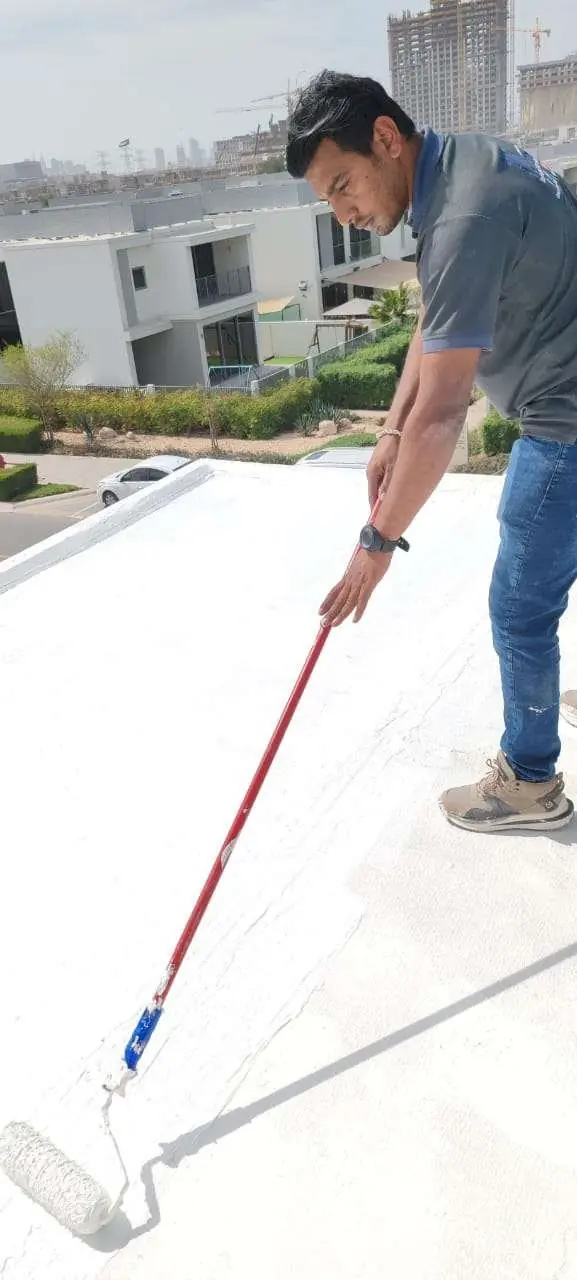
Liquid-applied membranes are brushed, rolled or sprayed to a specified thickness, curing into a continuous, seamless layer. Because there are no seams, they suit areas with many details — drains, pipes, AC plinths and wall junctions.
Different chemistries suit different jobs: PU for flexibility and exposed roofs, cementitious for damp substrates and tanks, and acrylic or hybrid coatings for reflective roof finishes. We specify after inspecting the surface.

- Is the surface sound, dry and well bonded?
- Will the membrane be exposed or covered?
- How much movement or cracking is there?
- Is there water pressure from behind?
- What finish goes on top — tiles, screed or coating?
- Are there many pipes and details?
Seamless protection, almost anywhere.
From small bathrooms to full roofs.
Bathrooms & wet areas
Under tiles, bonded to every waste.
Exposed roofs
UV-resistant, reflective top coats.
Balconies & terraces
Under tiles with threshold upturns.
Pools & water features
Immersion-grade systems.
Basements & lift pits
Cementitious tanking against water.
Water tanks
Internal linings.
How we carry out membrane waterproofing.
Every stage is photographed for your report, and nothing is covered until it has passed a water test.
Inspect & specify
Choose the chemistry for the surface and exposure.
Prepare
Repair, clean and dry the surface; round off corners.
Prime
Primer matched to the membrane and substrate.
Reinforce
Fabric or tape at corners, cracks and penetrations.
Apply in coats
Built up to the specified thickness, checked as we go.
Test & protect
Flood test, then tiles, screed or top coat.
Choosing the right system.
Specified after inspection — the surface, exposure and finish decide, not habit.
PU membrane
Polyurethane membranes stay flexible with building movement and suit exposed roofs with a UV-resistant top coat.
- Seamless and elastic
- Exposed-roof grades
- Good on complex details
Cementitious membrane
Polymer-modified cement coatings for wet areas, tanks and basements.
- Tolerates damp surfaces
- Tiles bond directly
- Suits tanks and basements
Fire-rated & mesh systems
Fire-rated membranes where specified, and mesh-reinforced coatings to bridge minor cracks.
- Meets project specifications
- Bridges hairline cracks
- Re-coating option for roofs
Choosing and installing liquid membrane waterproofing in Dubai
Liquid-applied membranes look simple: a coating rolled or sprayed onto a surface. In practice, the result depends on choosing the right chemistry, preparing the substrate carefully, curing it in the right conditions and building enough thickness everywhere, including the awkward corners. This guide explains how these systems behave in the UAE climate, what shapes the scope of a project and how to tell good membrane work from a quick coat of paint.
How a liquid coating becomes a waterproof membrane
A liquid membrane starts as a coating and becomes a continuous rubbery or cement-like skin as it cures. Some chemistries cure by reacting with moisture in the air, some by evaporation of water, and cementitious products by hydration, much like mortar. In each case the finished layer is only waterproof once it has cured properly and reached the thickness the manufacturer’s data sheet specifies.
Because the product is applied wet, it bonds directly to the surface and wraps around pipes, drains and corners without seams. That bond is a strength and a responsibility: if the substrate is weak, dusty or contaminated, the membrane will fail with it. Reinforcing fabric is embedded at corners, cracks and junctions so the cured layer can stretch across movement without tearing.
Matching the membrane to Dubai's heat, humidity and UV
Summer roof surfaces in Dubai become extremely hot, then cool sharply at night. That daily cycle makes concrete and screeds expand and contract, so exposed roof membranes need to stay elastic and resist UV breakdown. Polyurethane systems with a UV-stable top coat, or reflective elastomeric coatings, are typically chosen for exposed areas. Light-coloured finishes also reflect sunlight and help reduce heat absorbed by the slab.
Inside the building, conditions are different. Bathrooms, kitchens and balconies under tiles never see the sun, but they face constant wetting, cleaning chemicals and tile adhesive. Basements and tanks may face water pressure from behind, where cementitious systems are often the better fit. High humidity also matters during installation, because it can slow curing or affect the finish of some products. Good membrane waterproofing starts with an honest assessment of exposure, not with a favourite product.
- Exposed roofs: elastic, UV-resistant, reflective finishes
- Wet areas under tiles: compatible with adhesives
- Tanks and basements: tolerant of damp and back pressure
- Pools and water features: immersion-grade systems
Surface preparation and site conditions
Preparation usually takes longer than application, and it is where good and poor membrane waterproofing part ways. The surface is cleaned of dust, oil, old coatings and loose material. Cracks are opened and filled, honeycombed concrete is repaired, and sharp internal corners are rounded with a fillet. Existing coatings are tested for adhesion; if they lift easily, they must be removed rather than coated over.
Moisture in the substrate is checked before priming, because trapped water can cause bubbles or loss of bond in many liquid systems. Surface temperature matters too: very hot concrete in the afternoon can make some products cure too quickly or form pinholes. Many crews in the UAE therefore work early in the day, keep primed areas covered from dust and protect fresh coats from foot traffic.
What affects the scope and cost of a membrane project?
The chemistry chosen is only one part of the picture. The condition of the existing surface often decides the scope: removing failed coatings, tiles or screed adds labour and disposal. The number of details, such as drains, pipes, AC plinths and wall junctions, increases hand work and reinforcing fabric. Areas that must stay in use, such as an occupied apartment bathroom, need phased work and more protection.
Exposure and finish also shape the specification. An exposed roof needs a UV-resistant top coat, while a wet area needs a screed or tile bed above the membrane. Access, working hours set by building management and any testing required before handover all affect planning. That is why we inspect first and provide an itemised quotation, so you can see exactly what each part covers.
Common mistakes with liquid membranes
The most frequent problem is simply too little material. A membrane that looks complete can be thin over high points, sharp edges and corners, where it matters most. Rushing between coats is another: applying the next layer before the previous one has cured can trap solvent or moisture, leading to blisters and soft spots. Skipping primer, or using one not matched to the substrate, weakens the bond.
Detailing errors are close behind. Membranes that stop at floor level instead of turning up the wall, wastes that are not bonded into the coating, and missing fabric at changes of plane all leave paths for water. Finally, tiling or screeding before a flood test means problems are only discovered once finishes are in place and expensive to remove. A short wait for testing is always cheaper than lifting new tiles.
- Thin coats on corners and edges
- Recoating before the previous layer has cured
- No reinforcement at junctions and cracks
- Finishes laid before flood testing
Maintaining an exposed membrane roof
An exposed liquid membrane is visible, which makes it easy to keep an eye on. Look for chalking, fine surface cracks, worn patches along walkways and areas where the top coat has thinned. Keep drains clear so water does not pond, and avoid dragging equipment or standing ladders directly on the coating. Maintenance staff working on AC units should use protective boards on the roof.
One advantage of many liquid systems is that the top coat can be renewed when it weathers, without stripping the whole membrane. Arranging a periodic inspection lets small damaged areas be cleaned, primed and patched before water gets under the layer. If new equipment is fixed to the roof, ask for each penetration to be detailed into the membrane properly. Keeping a simple record of when the roof was coated, and with which system, also makes future recoating and repairs far easier to plan.
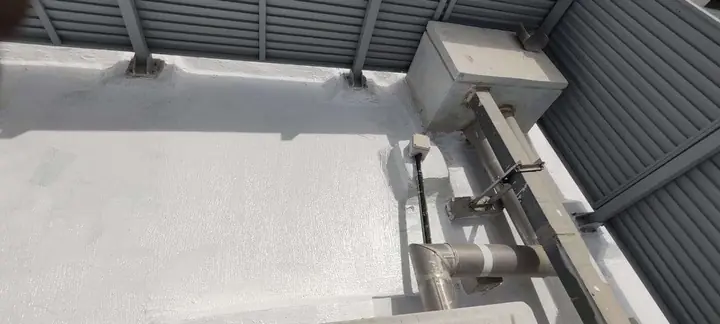
Real photos from our jobs.


Rated 5.0 by the people whose homes we’ve worked on.
Every review is from a real client on our public Google Business profile.
Outstanding company — changed my 3 bathrooms completely in 4 weeks. Walls and floors redone, new sealing, bathtub replaced with a rain shower, everything while I was away. Very professional and good value.
Excellent response time. Very professional and cost effective. Not in the habit of overcharging.
Highly recommended for any maintenance issues or any work that requires a contractor. These guys know their stuff.
Did an excellent job on my room ceiling. The finish is flawless and the attention to detail is commendable. Highly satisfied with their service.
Membrane Waterproofing — your questions answered.
Straight answers. If yours isn’t here, send it on WhatsApp.
Send two or three photos of the stain or area. We’ll tell you what it probably is and whether it needs a visit.
Is liquid membrane better than bitumen?
It depends. Liquid membranes are seamless and suit complex details and exposed roofs; bitumen is very robust under screed or tiles. We recommend after inspecting.
How thick should a liquid membrane be?
Each system has a specified dry film thickness from the manufacturer. We apply in coats and check as we go.
Can membranes be applied to a damp surface?
Some cementitious systems tolerate damp substrates; most liquid systems need a dry surface. That is part of the specification.
Do you offer fire-rated membranes?
Yes, where a project specifies a fire-rated membrane system.
Can tiles be laid directly on the membrane?
With cementitious systems, yes. Others need a screed or primer layer — specified per system.
How long should a liquid membrane cure before tiling or use?
Curing time depends on the product, temperature and humidity, and each manufacturer’s data sheet sets its own minimum before tiling, flood testing or foot traffic. In hot weather some products cure faster, while high humidity can slow others. We follow the data sheet rather than a fixed rule.
Can a liquid membrane be applied over existing tiles?
Some systems can be applied over sound, well-bonded tiles after thorough cleaning and priming, which avoids demolition. Loose or hollow tiles must be removed first, because the membrane can only be as secure as the surface it bonds to. We test adhesion during the inspection before recommending this.
What causes bubbles or pinholes in a membrane coating?
Bubbles and pinholes usually come from moisture or air escaping from the substrate while the coating cures, often made worse by very hot surfaces or applying coats too thickly at once. Correct priming, checking substrate moisture and working in cooler parts of the day help prevent them.
Related services

Reinforced sheets heat-welded with sealed overlaps — the workhorse for roofs and podiums.

Shower trays, floor wastes and wall junctions sealed with a continuous wet-area membrane — so water stays in the bathroom, not the ceiling below.
Flat, sloped and podium roofs — torch-on bitumen under screed, or UV-resistant liquid membranes on exposed roofs with AC plinths, solar frames and pipe penetrations detailed properly.
Fix the leak once.
Properly.
Tell us what you’re seeing. We’ll find the cause, show you the evidence and quote the right fix.